
review
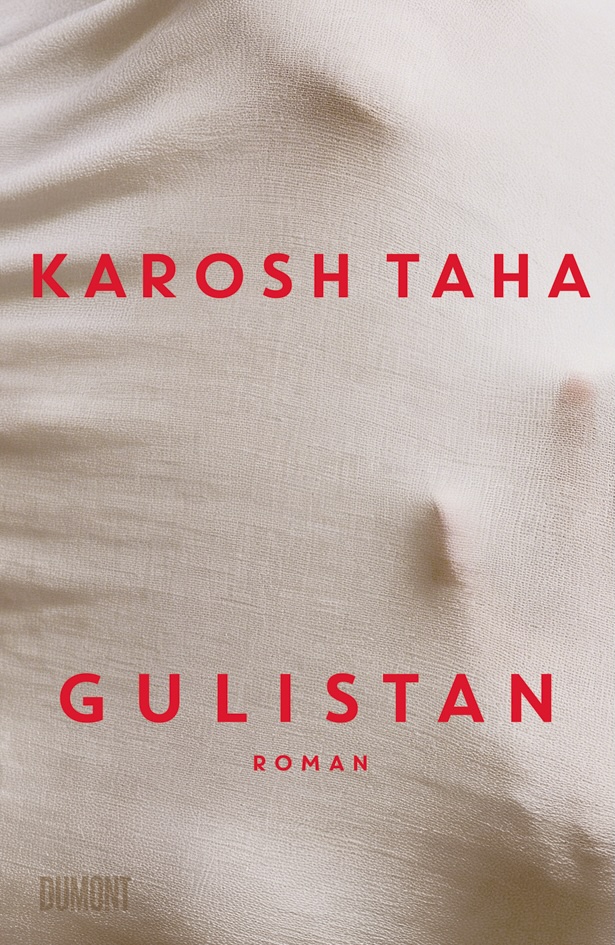
A haunting, formally inventive novel about dictatorship, disappearance and the enduring power of memory, ‘Gulistan’ is Karosh Taha’s most ambitious work to date: an immersive exploration of personal and collective trauma set in Saddam Hussein’s Iraq.
Gulistan, an art teacher at a university, lives with her husband, Çîya, a Kurdish tailor, whose shop bears the same name as his wife: Gulistan, meaning ‘flower garden’. When two men arrive to question him about the name of his business, the apparently innocuous conversation takes on sinister significance. Under a regime where language, identity and even hospitality are scrutinised, a misplaced word or social slight can prove fatal. Soon afterwards, Çîya disappears without trace. Refusing to accept the silence surrounding his disappearance, Gulistan embarks on a desperate search through hospitals and police stations, encountering intimidation, indifference and violence at every turn. Gulistan herself is interrogated, imprisoned and tortured, as her search expands beyond one missing man to become a testament to all those erased by dictatorship.
‘Gulistan’ exposes the fractured psychology of life under tyranny. Memories, dreams and hallucinations dissolve the boundary between reality and nightmare, while recurring images of bodies and voices become powerful symbols of a society living under constant surveillance. Along the way, Gulistan encounters figures who illuminate different facets of Iraqi society, from grieving families to the enigmatic Amin, whose shifting role reflects the moral ambiguities of complicity, survival and resistance. Although deeply rooted in the Kurdish experience under Saddam Hussein’s regime, the novel speaks more broadly to the mechanisms through which authoritarianism infiltrates everyday life and to the resilience of those who bear witness.
Taha combines lyrical intensity with remarkable formal experimentation. Shifting seamlessly between first- and third-person narration, prose and verse, the novel uses repetition, visual fragmentation and striking page layouts to mirror psychological disorientation and fractured memory. Kurdish words are woven naturally through the German text, while vivid physical imagery transforms bodies into repositories of grief and remembrance. Yet despite its experimental form, ‘Gulistan’ remains emotionally immediate, propelled by the urgency of one woman’s search and by the musical cadence of Taha’s language.
Following the success of In the Belly of the Queen (tr. Grashina Gabelmann, V&Q Books, 2023), Taha once again demonstrates her extraordinary ability to fuse political history with poetic innovation. Gulistan will appeal to readers of Sinan Antoon’s The Corpse Washer (tr. Sinan Antoon, Yale University Press, 2014) and Han Kang’s Human Acts (tr. Deborah Smith, Portobello/Granta, 2016) for its lyrical exploration of dictatorship, disappearance and collective memory. A bold, unforgettable novel, ‘Gulistan’ confirms Taha as one of the most original voices in contemporary German-language literature.
Find out more: https://www.dumont-buchverlag.de/buch/karosh-taha-gulistan-9783755812159-t-7857


All recommendations from Autumn 2026