Translator Steph Morris talks to NBG about the monthly translators’ workshop, the skills and habits he feels can help translators to succeed, and the creative challenges and pleasures of his own translation work.
Sarah Hemens: You run a monthly German Translators’ Workshop at the Goethe-Institut in London. Could you tell us a bit about how it works? What might someone expect if they attended? Is it necessary to be a professional translator to join?
Steph Morris: This is an informal workshop where translators bring work in progress they have questions about or would like feedback on. We discuss a fair amount of poetry, which lends itself to this format. When it’s prose, the translator either brings a short extract or marks the tricky passages within a longer extract. We also discuss drama and non fiction and have covered most genres, from popular fiction to obscure modernist texts. We love discussing translation solutions in obsessive detail, so be prepared to go deep, but we also talk about each text broadly, to establish a context for the translation.
You don’t have to be a professional; emerging translators are most welcome. You just need an adequate level in both languages. We have members with both English and German as a first language, and neither, or people unable to determine any more which comes first. Generally we discuss DE>EN translations, but sometimes the other way around. It’s fine just to come and listen and comment.
In your view, what skills or habits are most important for someone starting out in literary translation?
To translate you need a very good way with words – versatility, creativity, precision, and a sense of how words work to form meaning or create effect. This can be boosted by reading a lot in both languages and writing loads (also with peer feedback – I was going to creative writing workshops long before I started translating, and still do).
To make a career out of literary translation you need very different skills: persistence, drive, stamina and unshaking self-belief, also business/entrepreneurial, networking and (self-) promotional skills – the kind of abilities all freelance artists need, but not all are blessed with. These skills can be trained too, but don’t set out without addressing them. You don’t have to be Damien Hirst, but you do need to be fairly determined.
How do you see the balance between formal translation education and practical experience with peer feedback?
I learned mostly from the latter, so I favour it! But I did take the Diploma in Translation, and the preparation for that exam was a good education in translation principles. It doesn’t ultimately matter how you acquire skills as long as you put thought into your practice, have people who can give your feedback, and learn from your early mistakes. Learning on the job has the distinct advantage of being paid rather than costing money, and client feedback can be amongst the most rigorous. Translating a (short), challenging literary text of your choice for love, and getting colleagues feedback is also a great learning experience, and essential rite of passage.
Are there other translator communities or events or initiatives you would recommend than (aspiring) translators look in to?
If you are reading this and don’t know about the Emerging Translators’ Network and the UK’s Translators Association, those are the first places to look. If you live in a German-speaking country, you might want to join the local associations, such as the VdÜ – I was a member for many years and learned a lot.
Do you feel your background in visual arts has influenced your own approach to literary translation?
Yes. When I first started out, many translators, especially literary ones, were a little cautious about straying ‘too far’ from the original, to the detriment of the translations – I wasn’t. I tried to see my translation as a piece of its own, functioning autonomously. I tried to consider the effect it would have on the reader. I would always look for words and phrases which sounded good, and worry later about how closely they corresponded to the original. So I actually had to learn to be a little less creative sometimes.
Now there is a much stronger literary translation culture in the UK, approaching it as an art form and celebrating it, which has upped the game considerably.
What drew you to the works of Ilse Aichinger and Brigitte Reimann, and how did you approach capturing their voices in translation?
Those are two very different writers! With Reimann, it was her honesty, and fluent, direct writing style – ok these are diaries, not intended, at least initially, to be read by anyone else, but she set herself high standards. In all her writing, both fiction and journals, she was about emotional truth and lived reality and the integrity of her sentences. I set out to do nothing more than write like someone writing their diary with that degree of honestly; I tried to inhabit her world, which I was already immersed in thanks to her compelling writing.
Ilse Aichinger had very different literary concerns. She wrote differently in each genre, often setting out to perplex and confound expectations. The poems are highly atmospheric but sometimes baffling. I had to translate them in a state of ‘negative capability’, generate an effect without ‘torturing a confession out of it’ as Billy Collins said, describing the spurious search for meaning. The dialogues were very different. They are funny and absurd and quite mad, so making sure they were funny in translation was crucial. They had to be both surreal but believable.
I’ve also translated some of her short prose, which is different again, clear yet dreamlike, and reminiscent of Kafka, requiring precision.
Finally, do you have any final words for people thinking of attending the workshop?
I ask people to write to me first simply because sometimes we vary the 6pm, first Thursday format, such as when the Goethe-Institut is hosting a reading that night, which we wish to attend. It’s fine to bring snacks and drinks if you want. We have been hybrid since covid. Whether joining online or in person, it’s good to come a little early. I usually go early and read books in the library, so you may catch me beforehand.

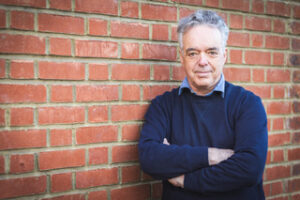
Steph Morris is a writer, translator, artist, gardener and cyclist based in London after many years in Berlin. His website is here.