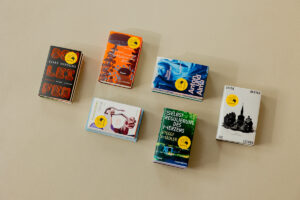

For more than two decades, Bitter Lemon Press has carved out a distinctive place in the publishing landscape by championing crime fiction in translation. It has brought English-language readers a wide range of international voices whose stories illuminate the social, political, and cultural realities of their countries. François von Hurter of Bitter Lemon Press talks to New Books in German about why translated crime fiction resonates so strongly with readers.
Sarah Hemens: When you founded Bitter Lemon Press just over twenty years ago, what drew you to crime fiction, and why do you think it is such a powerful genre for translation?
François von Hurter: We have always been fans of crime fiction, starting with American novelists of the 1950s all the way through to contemporary authors such as George V. Higgins, James Crumley, Patricia Highsmith, and Elmore Leonard. They told vivid, dialogue-driven stories with a social conscience at a time when postmodern fiction seemed to abandon narrative form. This was also true of the best representatives of international crime fiction—writers such as Simenon, Fruttero & Lucentini, Boileau & Narcejac, Glauser, Sjöwall & Wahlöö, and Padura. Very little foreign crime was being translated at the time, so there seemed to be room for publishing high-quality crime fiction from exotic places—fiction laced with humour that revealed the social underbelly of those countries. Some of the names listed above had never been translated, so we jumped in.
Do you find that crime fiction in translation has a distinctive tone or style compared to English-language crime novels?
Yes, and we try to avoid foreign novels that are merely imitations of English-language bestsellers or subgenres such as business thrillers or serial-killer narratives. There are plenty of those around, often fuelled by US film and TV adaptations. Countries such as Argentina, Cuba, Italy, Turkey, Croatia, and Germany have their own literary styles and, perhaps more importantly, their own histories of wars, dictatorships, revolutions, corruption, and regime changes that deeply inform their fiction.
You publish crime fiction in translation from many different countries. How do you go about finding the most exciting voices across such a wide landscape?
We have cultivated relationships with foreign publishers and agents who make submissions to us on a regular basis. But we also follow what publishers are doing in France and Germany—they publish many more translations than their Anglophone counterparts and, as we speak those languages, we can read their books directly. This has introduced us to novels from Turkey, Japan, Brazil, and Algeria, to mention a few. Wherever possible, we prefer not to rely solely on book reports or translation samples when making publishing decisions—we want to read the whole book.
Have you noticed any trends or shifts in German language crime fiction in the last couple of decades?
German language crime fiction has become more diverse in both setting and tone.
François von Hurter
Over the past twenty years, German language crime fiction has become more diverse in both setting and tone. Earlier works tended to focus on urban police procedurals or psychologically driven plots set in small towns. More recently, we’ve seen a turn toward regional and rural noir—stories rooted in specific landscapes such as the Alps, the Black Forest, or the Swiss valleys—with a strong sense of place and local dialect.
You publish a number of crime series, including, as far as German is concerned, works by authors such as Friedrich Glauser, Joachim B. Schmidt, and Hansjörg Schneider. What are the particular challenges and rewards of developing a translated series for an English-speaking readership?
They say the true sign of success in crime fiction is when the hero is better known than the author (forget the publisher—no one knows who they are). Think of Maigret, Sherlock Holmes, Sam Spade, Wallander, and Morse. This sets the bar very high, and I think it is just as difficult for Anglophone writers as it is for those who write in German. Of course, the German-language novels must reveal something unexpected about their societies, but in the end, they must create protagonists that readers want to spend time with again and again.
Many of your authors have won prizes and acclaim domestically. To what extent does that influence your decision to publish them in translation? How do international literary awards or festivals affect your publishing choices?
Prizes have an indirect effect on book sales. They influence local reviewers—pushing them, by FOMO, to review the novels in question—and reviews are useful. But I’m not sure novel buyers really care about prizes or even about reviews. They care about word of mouth, about what their friends tell them to read. Prizes are not a deciding factor for us when choosing what to publish.
Can you describe your relationship with translators from acquiring a book to its publication and marketing? How important is translator visibility for your press and readership?
Translators are very important to us—an importance that goes beyond the artistic quality of their work. Translators are the finest champions of the writers they love, and no one advocates for a book more passionately than a translator who believes in it. This has a strong influence on us as publishers and has often persuaded us to take on new novels. It is, however, rare that retailers and readers of international crime and espionage fiction focus on individual translators. That said, we often rely on them to help us create marketing campaigns and materials (including covers) tailored to the novels they have translated.
How do you think the global political climate influences the kinds of stories that you bring to readers? What role do you think translated literature will play in fostering global empathy and understanding in the coming decade?
Weakening corrosive perceptions of “the other” should always be our aim, and in modest ways, this can be achieved. We have to avoid overly preachy stories, but there is a strong argument for continuing to publish novels with a political and ethical conscience.
François von Hurter
The current return of the cosy genre (particularly in Japanese and English fiction) is said to be triggered by a desire to escape the relentless news of wars, massacres, and government failures. So far, we have not published such fiction. Our refuge, in the novels we publish, lies in humour—black, satirical, or otherwise. As for empathy for other societies and peoples, I think translated fiction has an essential role to play. Weakening corrosive perceptions of “the other” should always be our aim, and in modest ways, this can be achieved. We have to avoid overly preachy stories, but there is a strong argument for continuing to publish novels with a political and ethical conscience.
Learn more
New Books in German interview with bestselling and award-winning author Joachim B. Schmidt author of the Kalmann crime novels published in English by Bitter Lemon Press