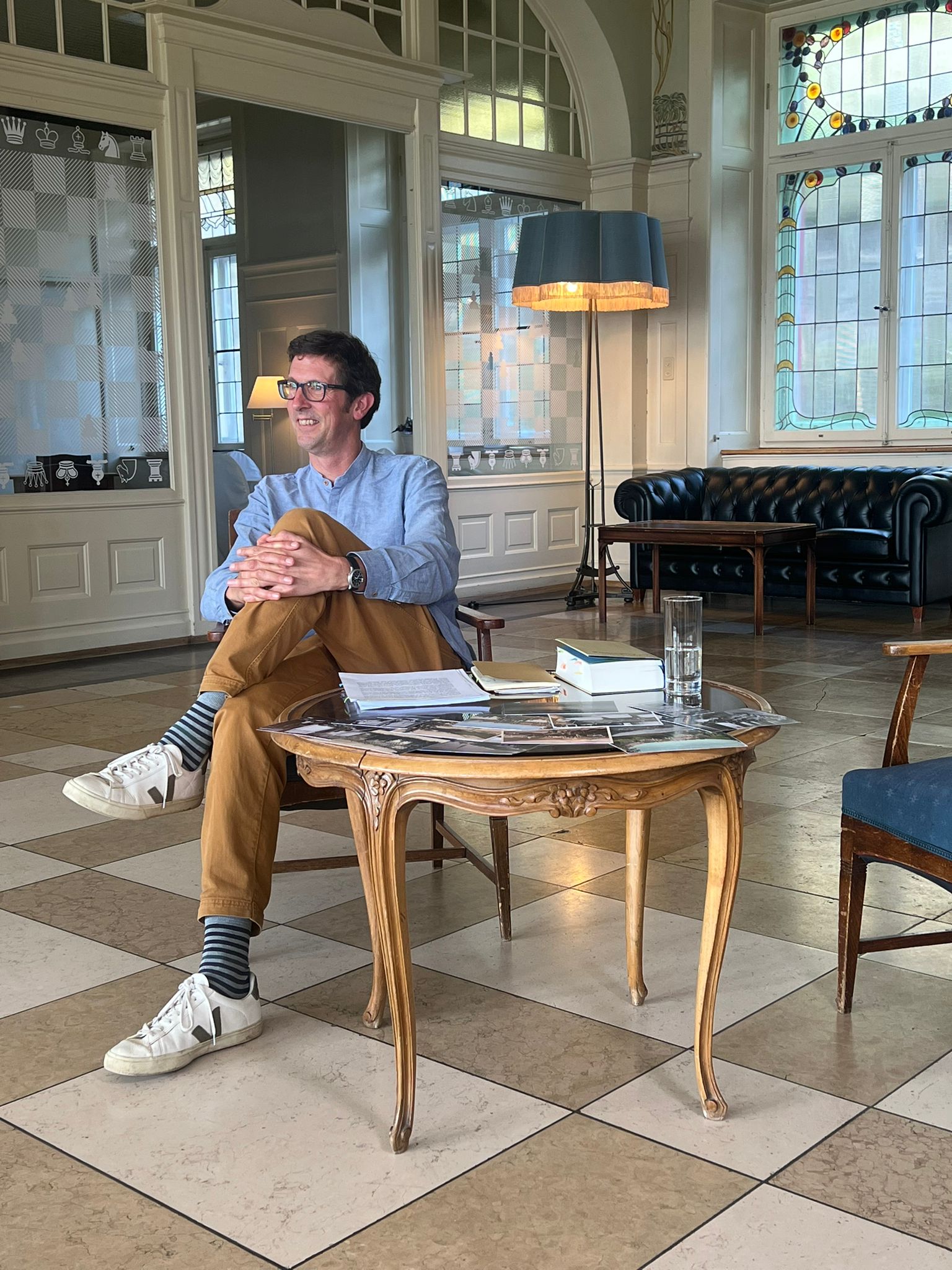
New Books in German speaks to literary translator Simon Pare about his career, communities of translators and making translation more theatrical.
Anna Compton: Why did you decide to become a translator?
Simon Pare: I had a kind of first career. I studied languages, but then I got into ecology and sustainable agriculture, and I worked in fairtrade for about eight and a half years. But then I found that I was really missing reading. I was getting a bit tired of my job and remembered loving translation classes during my degree, so I thought I might as well try that out.
AC: Could you tell us a bit about your career leading up to your first book translation?
SP: I started off working on a lot of film script translations and subtitles, because my wife had worked in film production before. It was a couple of chance meetings which made me think that I could have a path into literary translation. I started reading German literature for French publisher Albin Michel. I probably read 30 or 40 books, but none of them were ever actually published. They didn’t take any of my tips. One day I said in frustration: ‘Is there any point in me doing this? Do you ever take any of these books?’ And the head of translation said: ‘Yeah, I’m just looking through one right now.’ And it was Christoph Ransmayr’s The Flying Mountain. I read it and asked to be put in touch with its publisher, Fischer, which was looking for a new translator. Fischer liked my sample, and although I didn’t get that commission for another eight years, it was a great calling card which enabled me to go to the London Book Fair, meet potential publishers and talk to them about something specific.
On the strength of that, I started doing reader’s reports for people and, although I didn’t get to translate the books I reported on, one publishing house offered me another book, which I pitched to Little Brown, which then offered me The Little Paris Bookshop. So I had a slightly jolty, but quite serendipitous kind of path.
AC: Did you decide to specialise in translating certain genres or subjects?
The other thing is that, if you work in a variety of genres, you come into contact with lots of different editors with slightly different expectations of where the book is going to land and how to shape that book. I find working with different editors in different areas continually fascinating.
SP: No. If you look at the books I’ve translated, they’re just so weird. I sometimes get the impression they’re really all over the place. I’ve done quite a bit of commercial fiction, high-end literary fiction, free verse novels… I’ve worked on non-fiction, including a couple of books about the dialogue between Islam and Christianity. I do prefer literary fiction or good, narrative non-fiction, but there are things you like doing and then there are other opportunities that are a learning experience. And actually some of the commercial fiction turned out to be more challenging than some of the literary fiction. The other thing is that, if you work in a variety of genres, you come into contact with lots of different editors with slightly different expectations of where the book is going to land and how to shape that book. I find working with different editors in different areas continually fascinating.
AC: How do you approach the translation of a book? What is your process?
SP: Unless I’ve read the book already, I won’t read it first. I know that there are two schools of thought on this. My process is that I do a relatively quick first draft. And I have to accept that I’m going to flag up lots of issues as I go through it, which I will then come back to address. But because I have to go through so many drafts of each novel, I quite like the thrill of sitting down to a new text and discovering it as I go. I usually have other projects on at the same time, so I can switch between them for a breath of fresh air.
I’ve also recently started working in a shared office space sometimes, with a range of people from architects to butterfly specialists, and I’m trying to explore which parts of my work would benefit from being done in a space where I have a hum of activity behind me, and which are better to do at home. I’m really enjoying it.
AC: Do you have a different approach to fiction and non-fiction?
SP: Fundamentally, I don’t think so. I just always listen to the text, find out the register and try to stay true to it. I think you can be creative in both and import solutions from one into the other. It’s always interesting if there’s a phrase I’ve had to sacrifice in a novel that I can work into a non-fiction project.
AC: What do you enjoy most about being a literary translator?
SP: On a practical basis, I love the freedom it gives me. I have a vegetable patch and I row, and I can do those during the day and then work late if I feel like it. I suppose there are two things I love about the work specifically. One is working with authors. I find contact with the writers themselves very precious, being able to ask questions and suggest solutions to see what they think. The other is meeting other translators every month at the James Joyce Foundation in Zurich. People bring along their problems, their hard nuts to crack, and we sit around trying to work on them. There’s something incredibly powerful, special and dynamic about the creativity we have as a group. So there’s the community of translators on the one hand, and the relationship with authors and editors on the other.
AC: What has been your favourite book to translate? And what’s the most challenging book you’ve translated?
SP: The Flying Mountain will probably forever be my favourite. I find that it’s the best novel I’ve translated and that I’m likely to translate. And there was a whole constellation of contacts which developed around that book. My most challenging project has got to be The Magic Mountain, because of the weight of the past and the pressure of the project – thinking that it’s potentially the greatest 20th century German novel and I hope I don’t screw it up! Its sheer length also made it difficult to work out how to pace myself, how to remain consistent in my use of language and how to do the research into all the terms from that particular era that I didn’t understand.
AC: What was it like to translate Angela Merkel’s memoirs? How did you find working in a team, in a job that is often thought of as a solitary one?
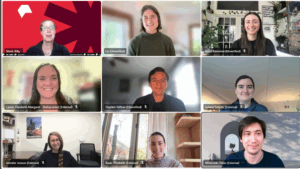
SP: It was completely different. The enjoyable part of working on Merkel’s memoirs was that all the translators actually saw each other every week in a Zoom meeting and used online tools to share questions, help each other out and build up a glossary. It’s a fun and rare opportunity to get to work on a common project. At the end of what was supposed to be the final meeting, we all said we wanted to meet one last time. And then as many of us as possible went along to the book launch in the UK. That was cool.
AC: Do you feel that there are enough opportunities for translators at all career stages to come together, foster skills and share tips?
SP: Yes, I think it’s easy for translators to contact each other and meet up. We can reach out to people we know who are interested in particular subjects or who’ve translated books in a particular area and ask for ideas. It just depends on us, doesn’t it? There’s also the Translators Association within the Society of Authors, which fosters a sense of community among translators. There are so many ways we can collaborate – I think our imagination is the only limit! Although, I suppose there’s also the question of whether there are funding bodies which will support this kind of activity.
A wonderful type of event I’ve been involved in is ‘vice versa’ workshops, which I’ve previously coordinated with a friend between French and English. There were five translators working from French into English and five working from English into French who all submitted a text. Then we lived together for just under a week and had sessions every day where people could read out their texts and ask questions. These workshops are totally amazing.
AC: What was it like to be a guest at the Solothurn Literature Festival last year? What did you learn from the event?
SP: First of all, I was immensely honoured to be able to go and talk. One thing I’ve regretted about living abroad, rather than in the UK, is that I very rarely get to read from my own translations. So I loved that I could read from the first chapter of The Magic Mountain. And Solothurn is a beautiful place where translators are held in high regard and made to feel incredibly welcome. I also met a translator from German into French called Alexandre Pateau, who has done a new translation of Dürrenmatt’s Die Panne, and puts on a touring theatre and dinner production of it. We were talking about what it’s like to retranslate classics, and I felt spurred on to be a little bit more theatrical. Not only in my reading that day, but also because I firmly believe that, as translators now, if we want to be heard and want people to find the questions of translation interesting, we need to dramatise our work. We can’t just hide behind a screen working on our book, then send it out into the world and wonder why maybe nobody is buying it. That’s one of the main things I took away from the festival. There’s a lot of fun to be had and a lot of benefits for the translation process of doing other events around our translation work. It’s up to us to invent things that draw attention to what we do… to create a stage to talk about translation. For example, when I did a reading from The Magic Mountain in Davos, I got them to dim the lights at the end, I projected a backdrop, I wrapped myself up in blankets, like they do in the book, and I read some of the ‘Snow’ chapter.
AC: That sounds great! What are you working on at the moment?
SP: I’m about to start translating a book by Gert Loschütz – Besichtigung eines Unglücks. It’s the second book in a kind of loose trilogy. I translated the first one, A Fine Couple. I’ve also been approached by a German novelist and poet who is writing his first collection of poetry and wants to do a bilingual edition. He’s done the first draft of the English translation himself and asked me to edit it. It’s an interesting challenge, and kind of exploratory for me, as I haven’t translated very much poetry before. Then I’ve just signed off on the proofs of A Shadow of Myself by Peter Flamm, which is coming out in October. It’s such a gem. I’m looking forward to seeing how people will react to it.
AC: Is there a book that you would love to translate?
SP: Yes, there is a book I would like to see revived in English. It’s called Murmeljagd by Ulrich Becher. It’s just the most fantastic novel. There’s an English translation from 1977, which is out of print. The novel is being rediscovered in German and it’s a total knockout.
AC: Thanks for taking the time to talk to me, Simon. It’s been a fascinating conversation!
Read Anna Compton’s interview with Simon about translating Thomas Mann’s The Magic Mountain here.
Photos © Simon Pare
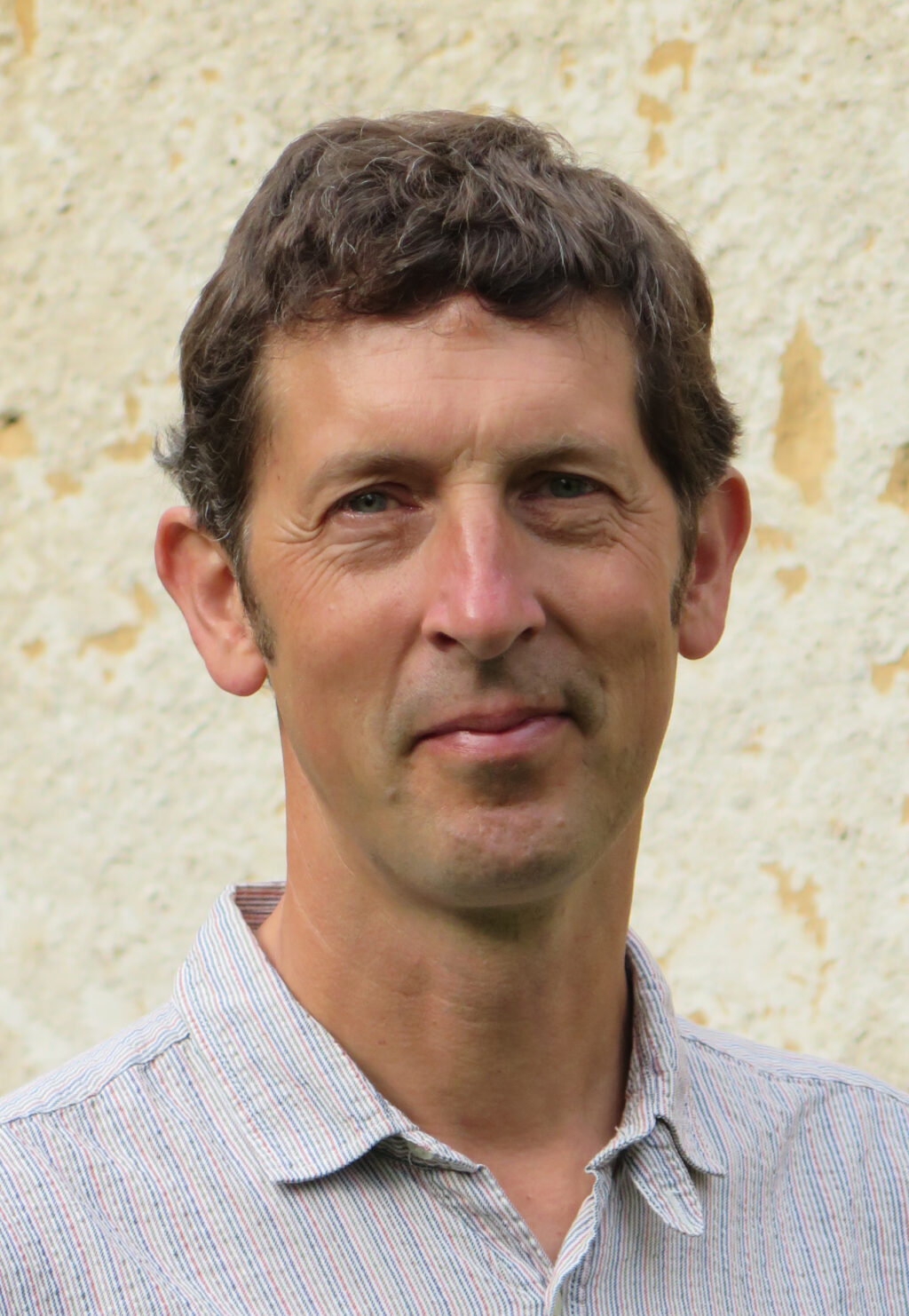
Simon Pare grew up in Shropshire and developed a love of foreign languages at secondary school, he studied French and German (and Occitan troubadour poetry) at Cambridge. After almost nine years working in ecology and sustainable agriculture, Simon became a translator working in literary translation and film. He currently lives in the Alpine foothills near Zurich.