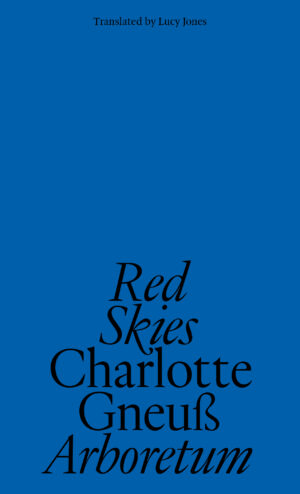
Sheridan Marshall speaks to translator Lucy Lee Jones about her translation of Charlotte Gneuß’s Gittersee, due to be published as Red Skies by Arboretum Books in October 2026.
Do you remember your first encounter with the novel and what made you think ‘I really want to translate this’?
I read the book for New Books in German, who needed a last-minute reader’s report. I remember having to read it fairly quickly and wanting to find out how it ended, being pulled along by the story. It’s written from the perspective of sixteen-year-old Karin Köhler, whose nickname is Komma. She has a very dry teenage voice which I liked immediately, especially because you can feel the forces around her not working in her favour, and that she’s alone in a terrible situation where her boyfriend has defected to the West and the Stasi are circling ever closer. They take advantage of her as a young person from a broken family, where her father is an alcoholic and her mother wants to break free.
I think the novel has a very modern voice that is compelling from the first page. I would say the story happens to be set in East Germany, rather than this being the driving force of the narrative. Because it’s a story that is known universally: a young girl of around sixteen who needs help, and yet doesn’t ask for it, or have anyone to ask. This is where Wickwalz, a Stasi officer, comes in and provides her with a listening ear. The world of the novel feels very contained within Karin’s worldview: you see everybody and the circumstances of their lives through her eyes.
Your sample translation that is up on the New Books in German website has all that in it and encapsulates everything that you’ve just said. I love the depiction of the pull she feels between caring for her toddler sister and the whole of the world outside her house.
What I picked up on was how Karin is still such a child, almost nearer in her perception of the world to the twin boys next door who are around seven or eight than her peers. Karin is stuck between the ages of these boys and the more worldly teens at school, and her vulnerability is partly because she’s trying to be an adult and trying to project this sort of worldliness.
I wonder if part of what makes Karin such a compelling narrator is that she’s constantly negotiating between what she’s revealing to us and what she’s keeping hidden, and how you might have recreated that in English? Is that something you were conscious of when you were translating?
As translators, we sometimes worry that we need to unpack complexity, thinking that the reader won’t understand. But readers do understand; readers are really smart. They can work out what’s going on, especially with writing of this quality. So I tried to capture the sparseness of the writing and leave the gaps that occur in the original.
Lucy Lee Jones
Yes, at some point, you realise she isn’t telling the whole truth, even to herself. This is partly conveyed through the lack of punctuation and the ambiguity this creates in the text. There are no question marks in the text, no inverted commas for speech. As translators, we sometimes worry that we need to unpack complexity, thinking that the reader won’t understand. But readers do understand; readers are really smart. They can work out what’s going on, especially with writing of this quality. So I tried to capture the sparseness of the writing and leave the gaps that occur in the original.
I think one of the novel’s great achievements is the way it makes the GDR feel like a lived reality, not just a kind of abstract historical time. As you say, it feels like the GDR setting is sort of incidental because the characterisation and the plot are so good in the novel. But did you have a sense of trying to preserve that sense of everyday life in East Germany, whilst also clarifying things for readers who might not have much sense of that time? Or did you just leave it to your clever readers to figure it out? Did you have to gloss much in the translation?
The premise of Charlotte Gneuß’s book is her discovery that up to ten percent of the informants recruited by the Stasi were minors, under eighteen. In the foreground of the novel is this targeting of young people by the state. The state apparatus sets them against each other, by getting them to inform on each other. At some point Karin and the others realise this – it’s a very divisive ploy among a group of teens. So what’s added to the story – the setting of a teenage peer group with all the associated pressure – is a state system bent on exploiting this. You’ve got this layer of authoritarian surveillance. Wickwalz talks about the values of the ‘bureau’ – the Stasi apparatus – which he tries to distil in Karin, a kind of moral code. And you can see that the teenagers who are being manipulated by him are missing the guidance they need from their parents. They are more or less all from dysfunctional families and that’s where the state steps in and styles itself as a parental figure.
You translated Brigitte Reimann’s Siblings, another novel rooted in the GDR. Did that work influence the way you approached Gittersee, or do the two books ask very different things of a translator?
They are very different books in terms of style: Gneuß uses a very pared-back style, whereas Reimann’s language is intricate and rambling, almost conversational. But the background research certainly helped – having absorbed so much information about the GDR and understanding the way things worked. I don’t think that there’s any specialist knowledge required to read Red Skies, which makes it a book that appeals to many different readers.
The voice was the most difficult thing to nail in Gittersee. Capturing this sort of age-old, wise teenager voice, that was the challenge. As soon as I got it, it kind of told me how to translate.
I have a question about that, because sometimes as a translator you hear the narrator’s voice in your head when you’re working, don’t you, like it’s giving you inspiration for the next sentence? Did Karin become one of those voices that stayed with you after you’d signed off work for the day?
Yeah, definitely. On that note, I went to see the stage version of Gittersee here in Berlin as well, but actually the actor who played Karin didn’t match my image of that character. She was a completely different kind of girl. I had this sassy, slightly precocious figure in my mind, who is also quite brave – someone who answers back. The girl in the play looked much younger and more innocent. I kept to my version of what she looked like in the end because I wanted to be consistent. So I thought it would help seeing the play but it actually changed my perception.
When I was in the audience, two women who told me they grew up in the East were sitting next to me and scrutinising the play, and I had the feeling they were there to assess whether Gneuß had got the GDR right. Afterwards, they were discussing whether anyone born after the GDR can write authentically about the period. I felt that I was seeing the play – and had read the book – with a completely different approach. It is a work of fiction, not a historical document.
These kinds of stories may not have been the ones that were told immediately after the Wall fell, but now I think that there’s room for them. The GDR had the full range of human experience, after all.
Lucy Lee Jones
Do you think that the fact that Charlotte Gneuß is from a younger generation changes the way the story is being told in a meaningful way?
I think there’s now room for other stories about the GDR – stories that can happen anywhere in the world such as a young girl being exploited and her trust abused by an older man. These kinds of stories may not have been the ones that were told immediately after the Wall fell, but now I think that there’s room for them. The GDR had the full range of human experience, after all. And the idea that this story, for example, could take place elsewhere in the world, actually makes it more interesting, to me at least, because it’s then not a book about the GDR, but a book set in the GDR about human relationships.
How much were you and Charlotte Gneuß in touch during the translation process?
I put together a list of questions for her and we met once in a café not far from where I live. We sat in this S-shaped seat where the other person was facing you when you sat down. The café was empty because there had been a storm warning, and I asked Charlotte to read to me so I could hear how it sounded when she read the novel. I realised Karin’s voice was much softer than the one I had in my head. I had imagined the voice of an angry, rebellious teenager, with a more dismissive tone. And as Charlotte finished reading, the storm started and the entire world felt like it was crashing down around us. All the public transport was cancelled – there were no buses, no trains running, and Charlotte was marooned in my part of East Berlin – it took her hours to get home. So it was a really dramatic meeting!
What a lovely idea to ask Charlotte to read to you!
It was very nice; she’s an incredibly gentle and empathetic person, and she has a wonderful storytelling voice. As far as questions go, I asked her one which she said she couldn’t answer because she didn’t know herself. Translators are the closest readers of texts, I think, and we sometimes ask things that authors find hard to answer. My question was about a character’s backstory, but she said, ‘I can’t tell you more than is written on the page.’
I also had questions about the geography of the book, spaces where I didn’t understand the exact layout, or the reasons for it. For example, the caretaker’s flat: living space in the GDR was regulated by the state and people were allocated flats. In the novel the caretaker is living in a building all alone because no one else has been allocated a flat in his building. I had to unpack that before I could get it right.
What about the title? Did you discuss that with Charlotte? How did you get to Red Skies?
The publisher and Charlotte initially suggested that the English title could be the same as the original, Gittersee, but I pushed against that – ‘Gitter’ has no associations in English, nobody would understand that is a name of a place near Dresden, or that ‘See’ means lake. So you’d have a book with a foreign title with no kind of pull. A fellow translator suggested following the lead of And Other Stories and having the novel’s first sentence appear on the cover, which is: ‘It is early in the day and late in the year.’ I suggested shortening that to ‘Early in the Day, Late in the Year’. But Charlotte wasn’t in favour of it. We discussed what the French publisher (The Innocence of Childhood) or Italian publisher (The Informants) had done, which were all good ideas too. In the end, as I was translating, I scanned the text for a good title: and one character says the German equivalent of ‘Red sky in the morning. . . ’, which I suggested turning into Red Skies. And although Charlotte was worried it might sound like anti-socialist propaganda, neither Tobias Nolte or I thought it would, and it was chosen in the end. So the German title has associations of water, the English with the sky and weather. And it looks very effective on the blue cover.
I wondered whether living in Berlin where traces of the former East Germany are still visible had any bearing on your translation or your sense of the book?
In turn, I think people’s feelings about the erasure of East Berlin have a bearing on their strength of feeling when it comes to writing about the GDR: The place itself doesn’t exist anymore, there are very few traces of it left, and this plays into people’s concerns about their stories being erased. These are their stories, their histories.
Lucy Lee Jones
I mean, it has a bearing on everything that I do. Berlin has been a part of my life since 1997. I’ve lived in this part of town since then, but what surrounded me back then is vanishing fast. When I walk around here, I have a ghost-town version in my mind of what used to be here. On every street there are places that no longer exist – they’re getting replaced with two things: either high-end furniture shops and clothes shops, or low-end nail and vape shops. This part of town is being totally erased through gentrification. It is becoming unrecognisable and there are now so few parts of Berlin that feel authentically East German, like when I first moved here. I have a hard time even remembering what it looked like nearly thirty years ago.
In turn, I think people’s feelings about the erasure of East Berlin have a bearing on their strength of feeling when it comes to writing about the GDR: The place itself doesn’t exist anymore, there are very few traces of it left, and this plays into people’s concerns about their stories being erased. These are their stories, their histories.
Looking back, was there a single sentence or a paragraph in this book that caused you more grief, or sleepless nights?
Yes, it’s something that Wickwalz says, which I eventually translated as ‘the innocence of childhood’. It comes up several times and is said by several different characters. I think the reason I chose ‘the innocence of childhood’ is because it is said by the Stasi man who’s manipulating Komma, and so it has a paradoxical meaning. None of his informants are in fact children anymore, partly through his doing.
That’s precisely what the Stasi were exploiting, isn’t it?
Yes, and it was one of those translations that took a few moments before I could settle on the right phrase. I had many different versions but I thought this worked best.
Readers often assume that translators spend most of their time searching for the perfect word. Is that true for you or do you think the real work is something less obvious?
Perhaps not the right word but the right phrase. I think that when I have found the voice, the words follow. So I try not to get too hung up on individual words. Today, for example, I sat back for a minute and looked at a whole paragraph and realised that the author was referring back to a particular thing a few hundred pages before. You have to start connecting the dots and seeing the whole book, and hopefully there are moments like these where you have the time to see the whole book from a distance.
Most of the time I try and stick to my instinct. If I feel something doesn’t fit the voice, that’s where I will plug away for a long time until I find the right word.
Luckily English-language readers are now discovering an increasingly wide range of German-language fiction in translation. Where do you think Red Skies fits in that landscape? What makes it feel distinctive to you?
What’s distinctive about it is how the reader experiences Karin’s recruitment into the Stasi almost incidentally rather than from an adult perspective. Red Skies is also written in a way that resists any easy moral framing and gives the teenagers involved in the regime agency, rather than being crushed by it. In the landscape of German-language fiction, it sits with other bold, evocative, voice-driven prose, which brings to my mind authors like Johanna Sebauer and Lion Christ, as well as echoes of themes of abuse explored by authors like Sarah Elena Müller in Bild ohne Mädchen (Picture Without Girl) and the young narrator in Vatermal (Birth Mark) by Necati Öziri, who evokes the feeling of endless waiting in teenage life.
Once readers finish Red Skies, what do you hope will stay with them? Maybe a particular character, or just a different understanding of the world that the novel depicts?
I think a more nuanced understanding of how the Stasi and its operations worked. The image people tend to have is of grey-suited men with old-fashioned listening apparatus sitting in a panelled room, like in The Lives of Others. I think the reality was far more pernicious, far more insidious, and calculating – attuned to exploiting people’s weaknesses. In Red Skies you can see that the Stasi were encouraged to go out on a limb and be quite sadistic. I think it’s an important takeaway from this book: that surveillance was happening in places where you didn’t necessarily expect it – and how this affected friendships and relationships. Your friends may not have been your friends. Most teens go through some kind of paranoia on this level but if you add a state authority to the mix, it takes on a new dimension. Peers and loved ones were doing the surveillance, not just men in suits in a room far away. It applies extra tension and pressure to an already difficult phase of life.
Thank you so much for your time!