In Robert Seethaler’s The Last Movement, we glimpse a few hours in the final journey that Gustav Mahler made across the Atlantic, from New York back home to Europe. Illness confines him to a small area of the passenger deck but his thoughts have free rein. Struggles and triumphs in his professional life and moments of great joy and deep grief in his personal life float to the surface of his mind. This short novel, translated into English by Charlotte Collins, is published by Canongate. Robert Seethaler spoke with New Books in German.
Mahler reflects on the fact that there are no words for life, death or music. This is a novel about all three. But is it not also a response to other artistic treatments of Mahler’s life and work? Are there not, for example, resonances with Death in Venice (both the novella and the film)?
I still haven’t read, or watched, Death in Venice. So I don’t know if there are parallels. But there are worse things than being compared to Thomas Mann…
There is an amusing encounter between Mahler and Rodin in this novel. Mahler is interested in creating music, not a marble effigy. You suggest that music, like life, is in flux, and point to a tension between the musical notation over which Mahler labours and the fleeting experience of a musical performance. Are you conscious of a similar tension when you write? What do you hope readers will take from the page?
A certain underlying tension is a necessary precondition to artistic endeavour, whatever form that takes. There has to be a definite drive or an intense focus. There are moments when everything flows and the art just seems to pour out. But most of the time it is hard work. Gustav Mahler was industrious, there’s no doubt, in fact, he was obsessed by his work. He was ardent in music and in love. All his life, he was on fire. In relation to his interests and goals he could be ruthless and tyrannical; at the same time, there was something very childlike about him. Angry. Furious to the point of self-destruction. A little flame in the whirlwind of his own agitation. I don’t know what readers will take from this book. That’s up to them.
Did you re-trace Mahler’s steps as part of your research for this book? Would his composing hut be a good place to write?
No. Lots of people picture a hut in the mountains, snow on the windowsill and so on. People think of nature as sublime. It is somewhere they long to be. But we shouldn’t romanticise. Mountains are as terrible as they are beautiful. People see in them what they want to. When we look at them from afar or dream about them, we see their beauty. As soon as we approach or climb them, there is an abrupt reality check. Then it gets unpleasant; it’s hard, windy, life threatening. Confronting the reality of nature is always testing. It’s the same with love.
Mountains are as terrible as they are beautiful. People see in them what they want to. When we look at them from afar or dream about them, we see their beauty. As soon as we approach or climb them, there is an abrupt reality check. Then it gets unpleasant; it’s hard, windy, life threatening. Confronting the reality of nature is always testing. It’s the same with love.
Robert Seethaler
In this novel, serious illness confines Mahler to solitary contemplation. The novel was first published in Germany in August 2020, during a year of Covid lockdowns. Was this a coincidence?
I wrote about Gustav Mahler, not about Covid. In Mahler’s day people had other battles to fight. With syphilis, for example.
Gustav gives Alma a copy of Peter Rosegger’s account of an impoverished 19th Century boyhood in the mountains of Upper Austria. Alma finds Rosegger sentimental and the book sends her to sleep. What is your view on Rosegger’s writing? Would you commend him to readers? Or are there books or writers that currently come higher on your list of those you would like to recommend?
Rosegger is certainly worth a read. Especially if you are interested in what life was like for ordinary people in the countryside. But I always recommend Cervantes’ brilliant Don Quixote.
A number of your books have been dramatised as theatre and film productions and have also been issued as audio-books. Have you been involved in any of these productions?
I was the reader for my early audio books. Since then, I have left it to others. There are many people who read better than I do. I have an Austrian sing-song and don’t think I read particularly clearly. I don’t get involved at all in the film and theatre productions. You have to know when to let go.
Given your parallel acting career, I wondered if you bring a method actor’s approach to your exploration of character and biography in your writing?
You don’t say ‘no’ to a director like Paolo Sorrentino, for whom I played a role in Youth. How often do you get the chance to hang on a rope over an abyss with Rachel Weisz?
Robert Seethaler
I don’t act much any more and have always tried to keep the two things separate. But certainly there’s an interplay between the two. They share a preoccupation with destiny and with language. But acting has always felt fundamentally foreign to me. I was always embarrassed on stage. When I write I can remain true to myself and let my imagination roam without having to put myself on display. Sometimes I still dabble in film. You don’t say ‘no’ to a director like Paolo Sorrentino, for whom I played a role in Youth. How often do you get the chance to hang on a rope over an abyss with Rachel Weisz?
Your latest book, Trotteln, which you wrote with the cartoonist Marcus Weimer, brings us into the smartphone era. Do you hope that it will reach English-language readers? Can we expect more in this vein?
I don’t think Trotteln is a book for English-language readers. But I think they will enjoy my latest book, The Street. Charlotte Collins is translating it and it is to be published by Canongate.
We look forward to reading it.
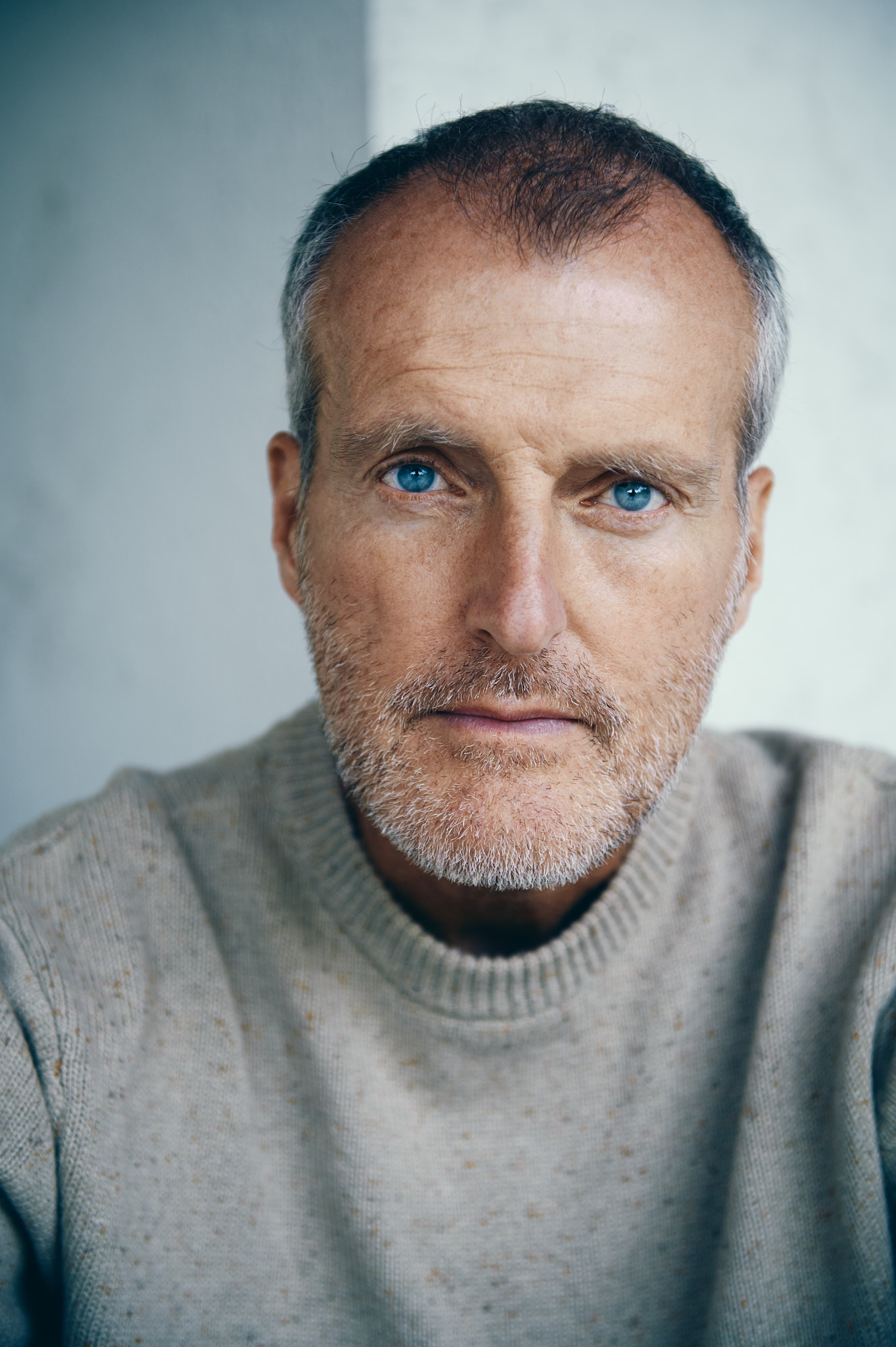
Author photo © Urban Zintel
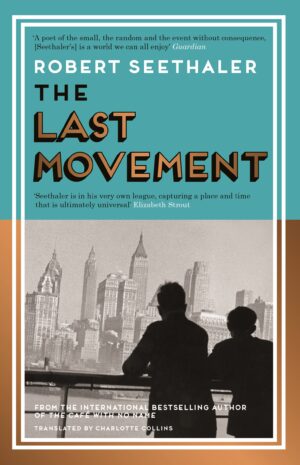
The Last Movement is out now.
Robert Seethaler also discussed his novel The Café with No Name with us, last year, you can read the full article here.
Charlotte Collins’ translations have garnered multiple awards. NBG interviewed her about her work on translating Bernard Schlink and Eva Menasse. Charlotte Collins also chatted to us about translating Nino Haratischvili.