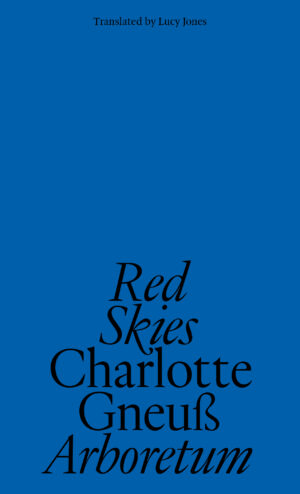
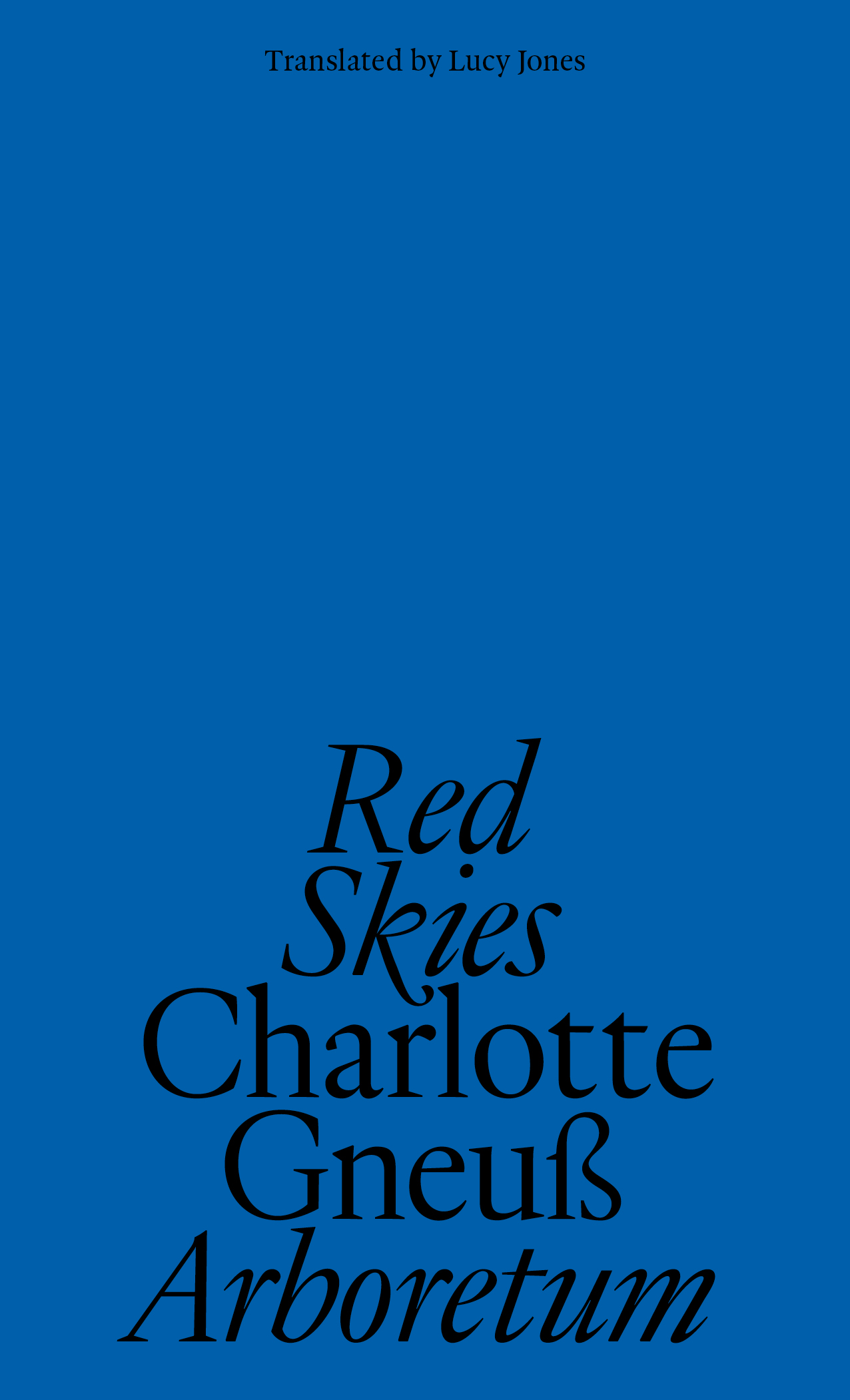
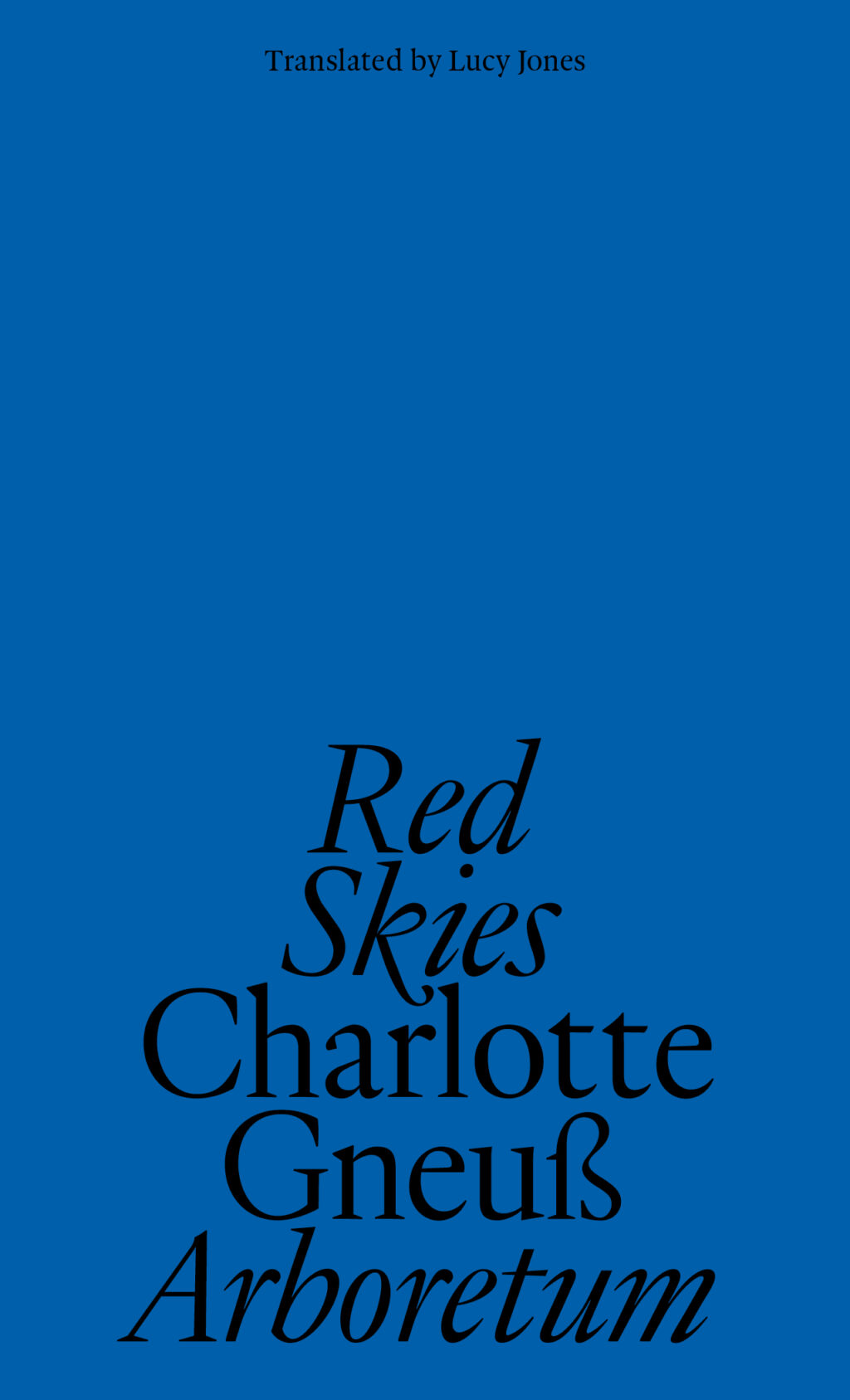
Sheridan Marshall spoke to Tobias Nolte, co-founder of Arboretum Books, on the day their first title – Charlotte Gneuß’s Red Skies, translated by Lucy Lee Jones – went to press!
SM: I thoroughly enjoyed speaking to Lucy Lee Jones recently, translator of Arboretum’s first title, Red Skies by Charlotte Gneuß. It was fascinating to hear about her work.
TN: Yes, Red Skies is going to press today. We’ll have the books in about a fortnight. Then Kate Ambler, my co-publisher and I will begin contacting independent bookshops to encourage them to stock and display it. We’re really building from the bottom up. It’s rather daunting paying invoice after invoice before you’ve sold a single copy, so anything that helps bring attention to a book we believe in – as this phenomenal debut – is enormously welcome. And we’re grateful for NBG’s incredible platform.
I don’t think I’ve ever spoken to a publisher before their very first book is out, it’s exciting! Can you tell us a little bit about your vision behind Arboretum, and how you came to set it up?
TN: We’ll be publishing books in translation, initially focusing on those from the German-speaking world, but not exclusively – that’s the language, as well as French, that I read in. One of the first four books, Adikou, is written by Raphaëlle Red, who is bilingual. She now lives in Berlin, but her debut novel was published in French. The ambition is to extend that and broaden our focus into a kind of European effort to bring voices that haven’t been translated to a UK and Irish audience.
The original idea goes back to a journey I made in 2006, and then to moving to the UK while remaining immersed in contemporary German-language fiction. I was always experiencing this impasse where I couldn’t quite talk about what I was reading with people here. I had a desire to convey to them what intrigued me and what felt compelling and worth sharing, but it always had to stop with my rather awkward and clunky summary of a book, rather than saying ‘here’s a copy of the it; let me know what you think.’ That really was one of the driving forces.
The final nudge came three years ago from a friend of mine from uni days who has become an important literature critic in Germany, Insa Wilke. She’s just been appointed as the head of the Bachmann jury from next year. I’ve been having conversations with her over the years and eventually she said, you need to stop talking about this plan and just try and make it happen now. She was extremely supportive. Her partner, Oliver Vogel, is one of the directors of Fischer Verlage, and the two of them put me in touch with the head of their rights department, Elisa Diallo, and I thought that this would just be a conversation where she will say, ‘Oh, that all sounds very nice, but there’s nothing I can do for you.’ To my surprise she spent a lot of time with me and it was really more of a mentoring conversation. She was extremely generous with both her time and insight. And that’s how it started. Red Skies is one of the books I was interested in from Fischer Verlage.
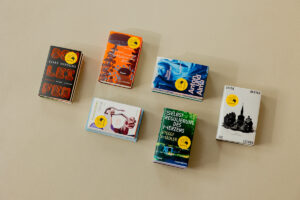
You can now see the first four books on our website, www.arobretumbooks.com. Very simple in design, in collaboration with Studio Clutto. It’s our way of emphasising that the books are really at the centre of what we’re doing and what’s to come – conveying also that the books are part of a series.
Yes, you can really see that – the Arboretum covers are very effective, it’s a lovely design aesthetic. I noticed that one three out of the four covers there’s an English word for a colour which is different to the colour of the cover that’s in the background. Two are from the titles and once the colour is part of the author’s name. It’s a really nice touch. I wondered if that was a conscious thing or just chance?
Well, the first one was chance. And then we spotted it with the design studio who are working on the covers with us, and we thought maybe we could just play with it a bit more.
How do you balance your literary ambitions with the practicalities of running a small press?
That’s complicated. I’m worrying a little about costs, as you can imagine, because there’s no mega-inheritance or any funder behind all this. I want to retain my day job because I am equally passionate about it and Kate works as a teacher part-time. The real desire is to bring some of these books which otherwise wouldn’t see the light of day in an English-speaking world to readers here. That’s very much where the passion lies.
I think things will get busier as we come to plan some author trips with the Goethe-Institut, and with all the publicity and advertisement work that needs to be done.
The press is situated in Hebden Bridge and London. That allows for different perspectives and connects us to a wider UK community of readers. My main role is as an Associate Professor in mental health research at UCL. And in the mornings I work as a psychoanalyst in private practice. There’s another kind of translation involved there, through insight into people’s worlds and unconscious experiences of their lives and relationships. It’s very different, but I think there’s some commonality in this role of translating something for someone, and in the acts of sharing and hearing stories.
Mental health has been a prominent theme in the titles we have profiled at New Books in German in recent years. Thomas Melle’s Haus zur Sonne is about bipolar disorder and was shortlisted for the 2025 German Book Prize. I interviewed him in December last year. I’m surprised it hasn’t been picked up by an English-language publisher yet because it’s a fascinating title with this powerful dystopian angle which I think would go down really well with readers here.
Then there’s Charles Lewinsky’s Eine andere Geschichte in which the whole story is told as a monologue by the protagonist to his psychoanalyst. The analyst never speaks in the narrative – his questions are just inferred from what the narrator is saying. The book is all about how you can have this one story which is your life story, but how your memories of the life you think you’ve lived can be a construction that you tell yourself – ‘a different story’ – to try and stay sane. I’m sure you would have a whole different perspective on it from your professional role. The novel revolves around the traumatic experience of participating in the liberation of Dachau that the protagonist has never spoken about, and which slowly emerges through his conversations with the analyst. The book is so beautifully constructed and clever. We’ve got an excellent sample translation by Ruth Martin on the New Books in German website.
I wonder how your psychiatry training might have influenced what you’re doing in publishing?
That’s very interesting to hear this observation of yours. I think the two worlds are not too dissimilar. There’s the therapeutic context where you listen to someone’s narrative and their stories very intently, to what’s there in between the lines and to what emerges in yourself as you’re listening. Whereas with reading you do this through a different sense organ, but it still speaks to the imagination and a conjuring up of an internal world. You connect with the story, with what’s said and unsaid. So in that sense there’s a close resemblance, but maybe the “trained” approach can also it get in the way at times?
There is something rather idiosyncratic in the curation of our list, which is primarily based upon what appeals to me as the initial reader. Hopefully, this is in line with what others find interesting – and where they have a sense of literature speaking to them, or disturbing them – that it stirs something up that can enrich. That’s something we don’t want to lose. We don’t want to just start looking at new titles through purely commercial lens.
I’ve come back to requesting physical copies of books to be sent to me. I know that it’s part of the industry that you sometimes have to read something early or as soon as it’s available, so that has to be as a PDF.
With social media, I’m very much in two minds. I didn’t use Instagram at all until maybe two or three months ago when we got closer to launching and then we found a need to have an Instagram presence. Then that also generates a strange economy of how you perceive what’s been written. You see things repeatedly and that becomes a pseudo-canon quite quickly. It’s probably both a curse and a blessing. I’m not sure yet what my stance is there; I’m still figuring it out.
Ironically, it was through Instagram that I discovered Women in Translation Month. I’m really pleased that three out of our first four books are by female authors and translated by female translators as well. We may “rebalance” the programme slightly next year. There was an interesting article in Die Zeit recently about losing male voices. Obviously the pendulum rightly swung one way because things had been so male-dominated for centuries, with few notable exceptions, and all diversity needs a hearing, gender categories probably don’t help us with that mission.
I wondered whether translators had played a role in shaping your list up to this point?
Yes, in lots of ways. By doing the actual art of translation, of course, but also by suggesting titles or sometimes offering a second view as a reader. Or unearthing someone’s writing we hadn’t come across. I think it’ll be nice if there’s a growing group of translators with such vast knowledge we’re working with.
We want to make sure translators receive the recognition they deserve and appreciation for what they’re doing – it’s not just the translation of the text into a different language; it’s an art form in and of itself. And there are costs for that; people need to earn a decent living. It shouldn’t just be a passion that gets exploited. Translators are supremely important and we would not be able to work without them. I think it’s a very generative relationship.
I wondered what excited you about contemporary German-language literature at the moment? Are there any particular themes or formal innovations that you think deserve greater attention?
I’m from the former GDR and there’s currently quite a resurgence in stories from that time. We’ve acquired the right for Lukas Rietzschel’s Sanditz and I’ve just finished reading Helene Bukowski’s Wer möchte nicht im Leben bleiben – another NBG title, about a gifted pianist born in the GDR who breaks down under the complex interplay of pressures from parents and the system. I really recommend it if you want to read something where the narration is stylistically quite unique. It’s a particular perspective where the narrator inserts herself into the story in the most gentle, thoughtful way.
Yes, it was shortlisted for the Leipzig Book Prize, wasn’t it?
That’s right. Our wish would be to see it out in English one day.
Then there’s obviously been the auto-fictional trend over the last two decades, which has been really important and necessary to express experiences that didn’t have a form beforehand. But equally, I’m very intrigued by a good plot. I think we also need to try and preserve the capacity to digest a proper brick novel. So that we don’t lose what comes into being by engaging with something in a more sustained way.
Do you think that English-language publishers have misconceptions about German-language writing?
I think – and maybe I’ll regret saying this – that English-language publishing simply has a capacity problem. I’ve been observing in the background for a long time, but I think the very agile and extremely productive indie publishers have picked up quite a lot. I think that German-language writing is underrepresented, and that there’s much more traffic the other way, from contemporary Anglo-American fiction being translated into Germany. But I think this has changed quite a bit over the last five to ten years. So I’m more optimistic than critical – I would want to encourage English-language publishers to keep going.
Of course the world is much bigger than the German-speaking world. We don’t want to become too boxed into a German niche, but to maintain a broader European perspective. What we’d want is that it’s not just the well-established, prize-winning authors, but that the others too can break through. Those who are more daring or more experimental, or writing about something that’s a bit more on the margins either in style or content.
What have been the biggest surprises – pleasant or otherwise – since launching your publishing house?
That’s very easy to answer – it’s the enormous amount of generosity and encouragement from other people in publishing and translation. Sometimes people say ‘that’s such a mad idea, an indie press for translated fiction – but do it!’ – that very much was the tenor across the board. I should really mention two people who have been very influential, as well as the friends I was talking about earlier: Jamie Bulloch and Katharina Bielenberg. They’ve really been very welcoming and given me the space to ask questions, and then put me in touch with other people. This was all facilitated by Nora Mercurio, who’s the Head of Rights at Suhrkamp. We met because we had things to discuss but it felt much more like a mentoring conversation than a business meeting. We also then bought the rights to Ozan Zakariya Keskinkılıç’s Hundessohn, which is hopefully another one for later next year, as well as Nina Bußmann’s Drei Wochen in August.
That was the experience across the board. I think there’s a sort of very healthy competition, one that is underpinned by a mutual delight in what the other one is doing, so my experience has been a very supportive and encouraging attitude. I’m very pleased about the camaraderie and solidarity – very much needed, I think, and something we’d like to return over time!
One final question: what can readers expect from Arboretum over the next few years, and have you got any particular projects that you are excited about?
I want to continue surprising myself with the books we choose, in the hope they’ll surprise readers too. We don’t want to narrow our list or become predictable. If readers come to trust that each Arboretum title will introduce them to something they didn’t know they were looking for, I’d be delighted. And we’re working on an essay anthology on Why Read?, so much as a little teaser.
We’re looking forward to seeing Arboretum grow and flourish over the coming months. Thank you so much for your time.
Read on!
Lucy Lee Jones reflects on translating Red Skies
NBG’s interview with Thomas Melle
Shaun Whiteside on how the GDR continues to inspire writers