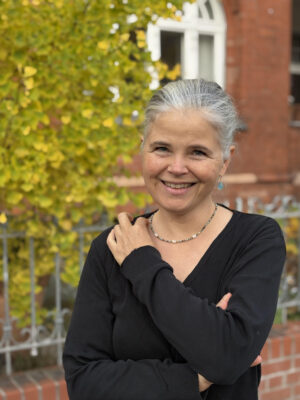
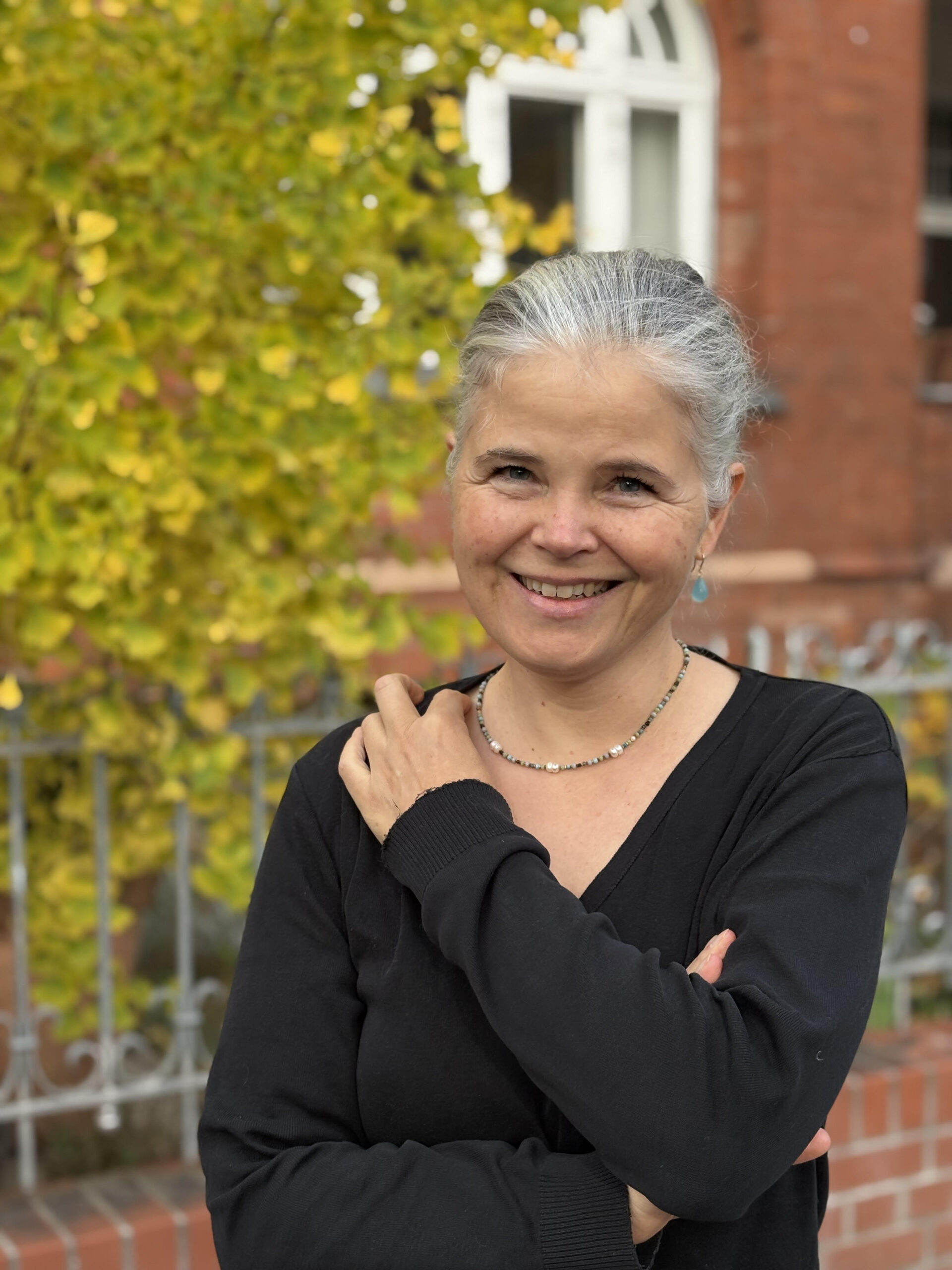
Julia Franck is a celebrated German author and journalist whose work has reached a truly international readership, with translations available in around forty languages. In 2022 Franck was awarded the Schiller-Gedächtnispreis for her lifetime achievement and contribution to German literature. In 2025 she delivered the renowned Heidelberg Lectures, a series of three public lectures on the theme of ‘Das Unbekannte’ (‘the unknown’).
Born in 1970 in Berlin, Franck spent her early childhood in the German Democratic Republic before moving to West Germany with her family in 1978 – an upheaval that would leave a lasting mark on her life and later become a central theme in her writing. She went on to study German Literature and American Studies at the Free University of Berlin.
Over the past several decades, Franck has established herself as one of the most distinctive voices in contemporary German literature. She is the author of six acclaimed novels, including Die Mittagsfrau (The Blind Side of the Heart), winner of the 2007 German Book Prize, as well as numerous short stories and essays. Two of her novels have been adapted into feature films.
Much of Franck’s work is concerned with the interplay between personal and collective history. Themes such as the ruptures of twentieth-century Germany, the enduring impact of war and division, the fragility of family bonds and the complexities of motherhood recur throughout her oeuvre. Her elegant prose is characterised by its emotional intensity and unflinching honesty.
In her auto-fictional novel, Welten auseinander (‘Worlds Apart‘), Franck returns to the landscape of her own childhood to tell the gripping story of a family fractured by political upheaval, migration and internal turmoil. Moving from East to West Germany, the narrative charts the formation of a young girl’s identity under extraordinary pressure, tracing the early development of a future writer navigating experiences that verge on the unbearable. At once intimate and far-reaching, ‘Worlds Apart’ illuminates both a singular life and the broader history of a divided nation.
‘Worlds Apart’ is being translated by Imogen Taylor for Moth Books and will be published in February 2026. You can buy tickets to attend the launch on Thursday 5 February at the Goethe-Institut London, here.
Your recent book, Welten auseinander, is a work of autofiction. Could you tell us how it came into being, and when you knew that you wanted to tell this story in literary form?
My childhood and teenage experiences contain the archaic motifs of literature. For decades, I needed fiction as a protective shell in public. I was able to talk to friends or my therapist about my own experiences, the pain, the echoes of those young years. As a child and teenager, my diary and fiction were separate.
In the midst of this life full of ruptures, losses, and traumas, writing had become existential for me. Between the ages of ten and twenty-seven, I filled thirty diaries; I think I filled ten in my thirteenth year alone. Pain, insecurity, hurt, and shame are closely related. As a younger person, I would never have wanted to select and arrange my autobiographical traumas in literary form, nor would I have wanted to tell them to a public I did not yet know.
It was obvious that I needed to grow older first. My children needed to be able to grow up and become adults in peace. Children need security and protection, including protection of their privacy. Before, it would have seemed completely wrong to me for a mother to share her own story in public. After turning fifty, I felt a growing sense of calm and courage to engage with this period of my life in literary form. I no longer wanted to write “around” it. The experiences of my first twenty-five years shaped me profoundly and still resonate today. But those echoes have grown fainter; those waves are no longer a tsunami capable of sweeping me away.
A family history like this, and one’s own early years, are easier to recount in retrospect. It requires time and the composure that comes with age. The book ends when I am twenty-three; I don’t talk about how I became a writer or how my children were born.
Welten auseinander portrays a childhood between East and West, marked by rupture, insecurity, and existential questions. What insights about identity, belonging, and uprootedness emerged for you while writing?
These are among the oldest motifs in literature; religious texts, fairy tales, and legends all revolve around them. I have no interest in formulating abstract concepts of identity or belonging, that would be meaningless. Contrary to our culturally ingrained anthropocentric assumptions, we are not masters of our own destiny. There are genetic and social conditions into which a person is born, as well as the political situation. No one can choose whether or what kind of love, security, trust, protection, or care they experience as a child.
What matters is to what extent a person succeeds in developing love and respect for others, for nature, and for animals. Early responsibility and worry shape children within relationships, including relationships in which we give more than we receive, relationships that are self-exploitative or abusive. What a privilege it is to have been born as a woman in twentieth-century Europe, to have learned to read and write, and to be allowed to publish literature.
Many readers know you primarily through your historical novels such as The Blind Side of the Heart and Back to Back (both translated by Anthea Bell). What new narrative possibilities does autofiction open up for you, and how does this approach differ from your earlier novels?
In Welten auseinander, I work with an entirely different kind of dramaturgy. I do not unfold a continuous timeline or tell a chronological story. Instead, I write associatively and thematically, drawing on memories, letters, documents, and diary entries. Remembered scenes sit alongside – and sometimes even contradict – those recorded in diaries or letters, or those I know from the oral accounts of others.
There is no such thing as objective experience; hardly any event can be recounted without subjective perspective. Like a kaleidoscope, the gaze falls on details from different angles, forming patterns that shift depending on how one looks. The book traces the transmission of certain traumatic experiences: violence, abuse, loss or absence of father and mother figures, neglect, and the loss of a close companion. Nothing in Welten auseinander is invented. In The Blind Side of the Heart and West, all characters are fictional. Back to Back is different; strictly speaking, it is also a family biography. Anyone who reads ‘Worlds Apart’ will sense how little in Back to Back is freely invented.
Your work often explores family structures, motherhood, and the fragile balance between care and injury. What new perspectives did engaging with your own biography open up for you?
My literature often deals with working women whose professions allow them a certain independence from patriarchal protection, with loneliness, self-determination, ideology, and self-deception. I was shaped by my grandmother’s generation – she was a sculptor who worked well into old age. Until the late 1960s, women had very little control over whether or when they had children. My grandmother once said, “I am not a mother by profession.”
You write about traumatic experiences with remarkable calm and clarity. Was this linguistic restraint a conscious aesthetic choice, or did it emerge from the attempt to do justice to what you experienced?
Both are true. When literature deals with existential matters and almost unimaginable events, the language becomes restrained and clear on its own. There is no need to stage drama. Think of Imre Kertész’s Fatelessness, Ágota Kristóf’s The Notebook Trilogy, or Marguerite Duras’s The Pain.
Political systems play as great a role in your book as intimate family relationships. How do you see the interaction between private and societal trauma, particularly in the context of divided Germany?
This question is answered by Welten auseinander itself. The history of divided Germany is reflected in every social microcosm, in friendships and in every family. The Stasi deliberately infiltrated the most intimate human relationships. Deeply rooted antisemitism gave rise to National Socialism in Germany. Without National Socialism and the war, there would have been no division of Germany. Very few of the Jews who managed to escape into exile at the time ever wanted to return to Germany. Some members of my family did. It was no coincidence who chose to live in the East and who in the West; those decisions differed within my grandmother’s generation. She had been born and raised in West Berlin, yet after the war and her return to the city she moved to the East. Her brother, and later her cousin from Israel, settled in the West instead.
You have emphasised in interviews that memories shift, overlap, and sometimes contradict one another. How did you approach reconstructing your childhood experience, and what role did literary imagination play?
Anyone who keeps a diary knows that it records only selected events. Alongside this, we have living memories and the documents and memories of others. My memory of the first fifteen years of my life developed closely alongside that of my twin sister. From early childhood onward, we reawakened memories together – of experiences, friends, relatives, places – and often contradicted each other, sometimes even arguing about them. It quickly became clear that perspective and empathy are decisive.
Was my sister struck by a third person, or was I? When people are very close to us, we experience violence as witnesses, so that the pain and the observed event become equally embedded in memory. Moreover, the truth of certain decisions and events rarely comes down to either-or. Both can be true.
One concrete example: In my adolescent self-image, it was important to me that by around eleven I increasingly felt superfluous and out of place, and by twelve I sensed that I had to leave home. I felt there was simply no space for me; I was being crushed between conflicts and the needs of others. Our mother was overwhelmed during those years; she suffered from severe depression with manic features. She had a few friends, changing lovers, and many animals she had to care for. We lived on welfare. We older children were left to ourselves, expected to manage the chaotic household and care for our then youngest sister. I suffered within that family constellation and developed numerous psychosomatic symptoms. I therefore persistently and tearfully fought to leave.
In later years, I drew strength from the idea that I had escaped, that I had summoned the courage for this unusually early separation. Decades later, however, Steffi gently corrected me. She told me that it hadn’t really been the case that I insisted on leaving. Rather, our mother had called her one day and said that I had to go – she wanted me out of her immediate environment. She framed this in a way that appealed to Steffi’s compassion, which led to Steffi and Martin offering to take me into their home in Berlin.
Steffi’s memory opened my eyes to the likelihood that both versions were true. I was not only mostly irrelevant to my mother; she also wanted me gone. Not necessarily out of lovelessness, but because in the rare moments when she truly saw me, she perceived how much I was suffering. When I read my diaries again – ten from 1983 alone – I encountered the voice of the thirteen-year-old I once was. Her observations and emotions testified to many events I could only fully recall in detail when rereading them decades later. And my voice then sounds different to how I remember it being, as well as different to my adult voice today.
Like most people, I remember puberty as a very difficult time, full of self-doubt and the hope of one day growing into independence. I remember the adolescent feeling of believing, from one’s own central perspective, that one can clearly see and understand the world and the people around one. Writing helped me gain awareness during my youth.
In Welten auseinander, I do not write that my mother suffered from “depression” or bipolar disorder, or that I was born into a “dysfunctional” family. These kinds of labels are not meaningful in literature. Literature relies upon precise, vivid description – on showing how people behave. Diagnostic terminology belongs to sociology or psychology.
Many of your novels have been translated into multiple languages. What does it mean to you that Welten auseinander will soon be accessible to an English-speaking readership?
I am pleased that my literature can be read in the English-speaking world. Perhaps the book opens readers’ eyes to how similar and how different our lives are. Between our cultures and languages, there are stereotypes about what Germans are like – orderly, punctual, and descendants of hardened Nazis, regardless of East or West. None of this applies to Welten auseinander. I neither cater to expectations nor reinforce stereotypes.
What has it been like working with your translator, Imogen Taylor?
I am immensely grateful for Imogen Taylor’s translation. She is an exceptionally experienced and skilled translator. I can read English and French and speak them reasonably well, but I could never develop a literary voice of my own in English. It just isn’t my native language.
Several of your books have been adapted for film. Could you imagine a screen adaptation of Welten auseinander, or would this book be too personal for you?
No, I cannot imagine a film adaptation of Welten auseinander. Perhaps because the inner images are already so vivid and powerful. But every literary adaptation becomes a surprising and autonomous work in its own right. The images on screen never correspond exactly to those a reader forms internally, or those an author creates through writing.
What kind of responses to the book have you received from readers with similar experiences?
The responses to this book have been highly emotional. I know very few people who grew up under such fractured circumstances. I don’t know anyone who grew up with four sisters and lots of different fathers, or without a father at all, coming from the East on welfare and living on the precarious margins of society during the West German economic miracle. I don’t know any other white person of my generation who lived in a refugee camp with their family for nine months, nor do I know anyone who lost their great love in their early twenties.
Reading the book probably arouses compassion; some readers have told me they cried during the final quarter. At the same time, however, it is also a funny book. Self-perception and the perception of others contain a beautiful comedy in all their contradictions.
Can you tell us about your current or upcoming projects? Are you already working on a new novel – and does autofiction remain an option for you?
This autumn, a literary essay will be published about the ill-fated love affair between the German-French Jewish painter Baladine Klossowska and the German-language poet Rainer Maria Rilke. After months of research and writing, I am now revising, adding, and cutting. I have completely fulfilled my urge for autofictional writing with Welten auseinander. I find reflecting on my adult life, in which I became a writer and had children, relatively uninteresting. Other people and other lives are always more compelling. A degree of privacy around family and friends is very important to me. Even in Welten auseinander, I left many things out to protect the privacy of those close to me.
Finally, a classic question: What books are currently on your bedside table, or which authors are you particularly enjoying at the moment?
As I am currently in an intensive phase of work and revising my manuscript, I am not reading any novels at the moment. I am reading hundreds of pages of letters that they wrote to each other in French, researching letters that they wrote to others, and also reading non-fiction texts, including Sartre’s ‘Anti-Semite and Jew’. I really enjoy reading Yukio Mishima and Ariyoshi Sawako, and I have books by them on the chest next to my bed. Hardly anything by Sawako has been translated into German, so I get to read English and French. These novels are there as a reward and will have to wait until I have finished my current work and can finally read novels again at my leisure.
Thank you very much for your time.
Celebrate the publication of Worlds Apart at the Goethe-Institut London. On Thursday, 5th February, Julia Franck will be joined by her translator Imogen Taylor for a Q&A moderated by Katja Hoyer, journalist and historian. Book here.
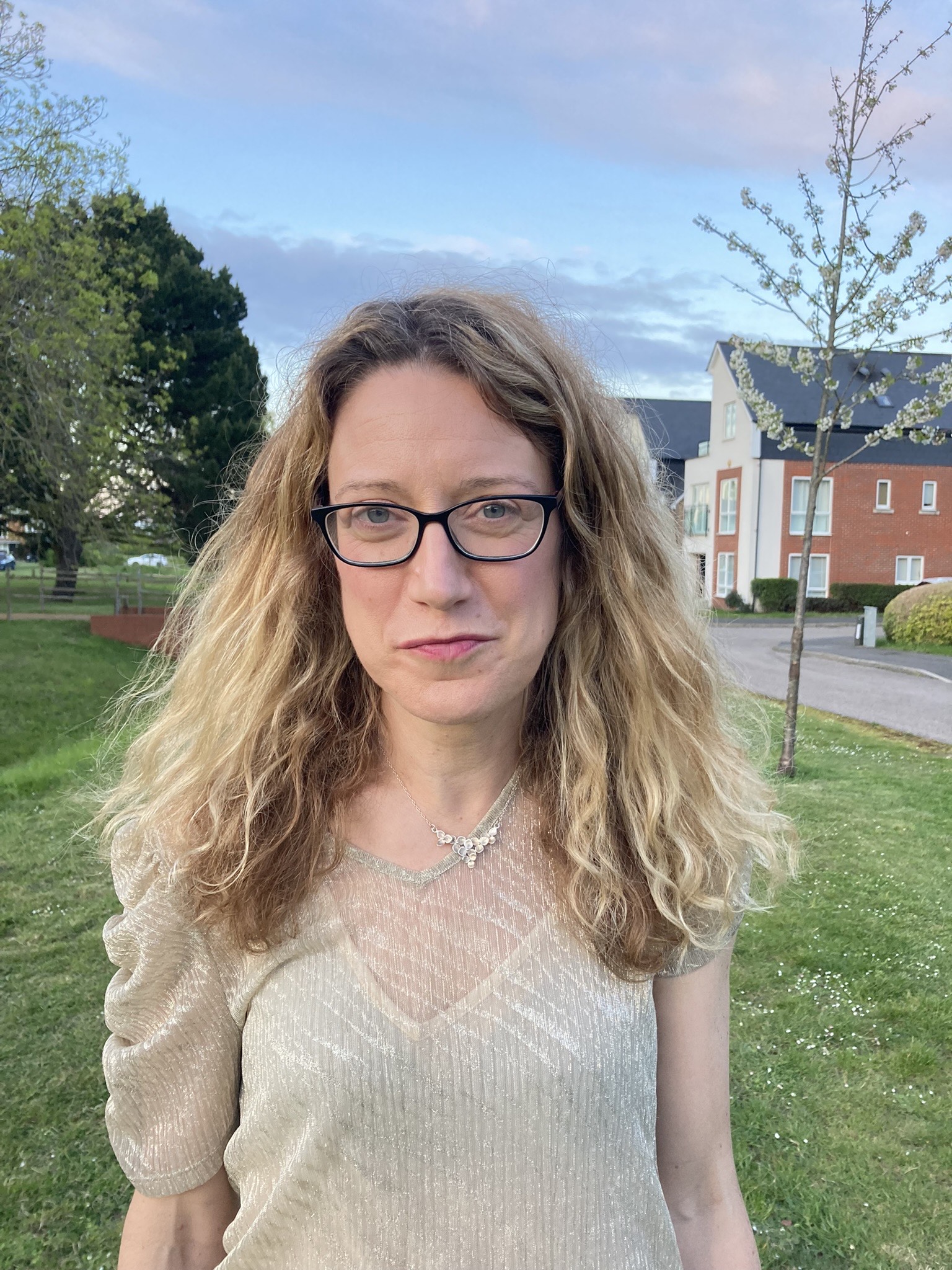
Sheridan Marshall works as Editorial Consultant for New Books in German. She is a translator from German into English.