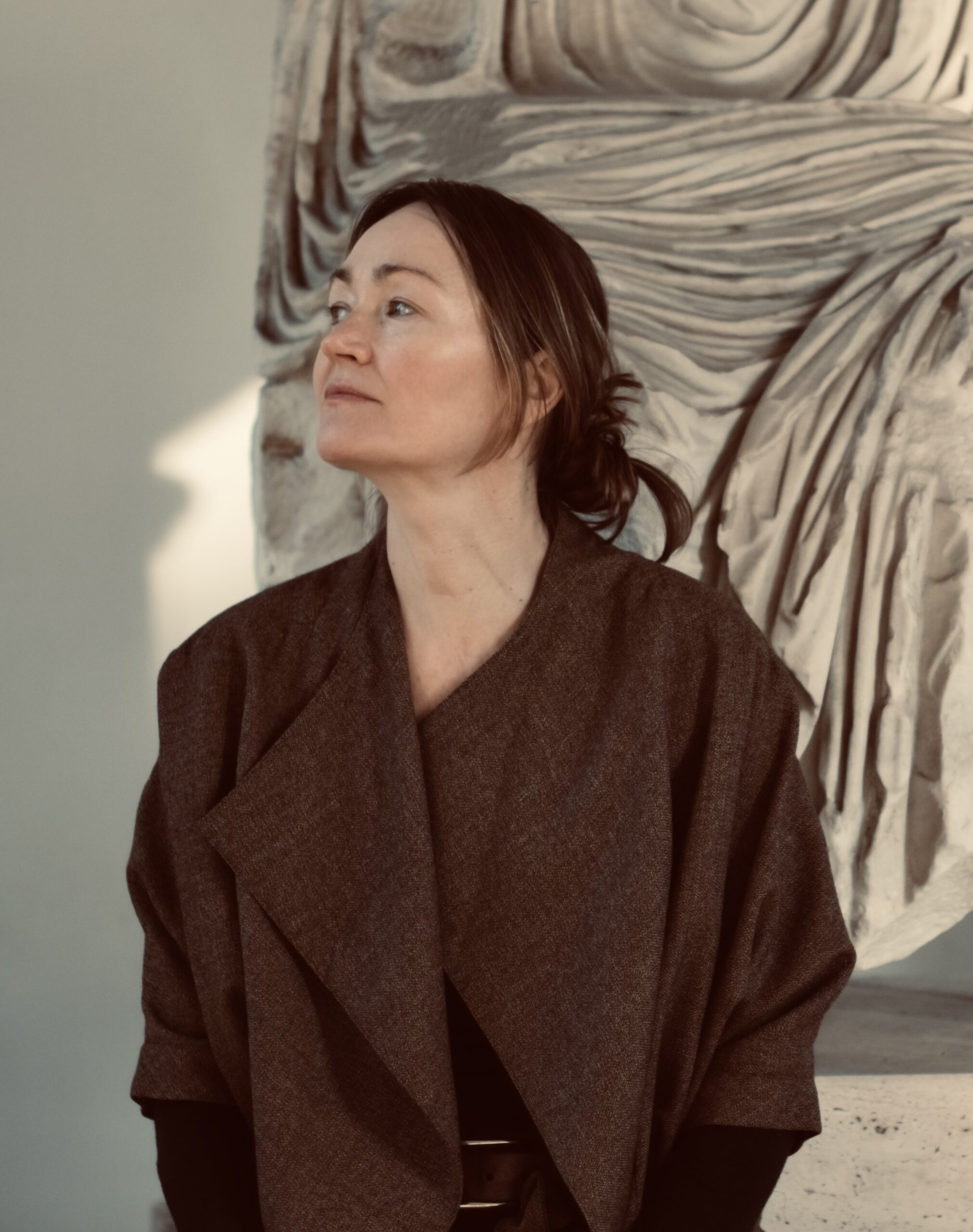
New Books in German speaks to the winner of the 2026 Leipzig Book Fair Prize, Katerina Poladjan.
Huge congratulations on winning the Leipzig Book Fair Prize, and many thanks for taking part in this interview with New Books in German. You’ve described Odessa as a ‘mythical place’ and a ‘city of light.’ How does the current reality of Odessa as a city under threat influence your depiction of it as a lost paradise in the manuscript?
I was interested in ‘places of longing’ – their promises, attributions, and re-evaluations. Goldstrand begins with a flight from Odessa to escape the Bolshevik purges in 1922. Leon Trotsky said of the people on the so-called ‘philosophers’ ships’: “We have exiled these people because we found no reason to shoot them, but it was impossible for us to endure them.” Half a century later, during my childhood, Odessa was a holiday paradise – a cosmopolitan place by the sea that people visited for relaxation and cultural stimulation. Now, another half-century later, Odessa is once again a place from which people must flee war and violence. I believe it requires detours through history to introduce the present to itself. In the novel, it says: “[She] looks at the white foam of the wake, then into the darkness, where the lights of Odessa have long since disappeared.”
The novel moves between Odessa, Varna, Balchik, Rome, and eventually back to Bulgaria. You’ve mentioned that ‘remembering is a creative act.’ How did you use these specific locations to map the characters’ inner struggles with their pasts?
I believe my writing is shaped by a strange mixture of calculation and almost arbitrary choices. I wanted to write about the philosophers’ ships. I spent a year in Rome. A rainy holiday landed me on the Bulgarian Black Sea coast. I wanted to write a European novel. Then I leaned over a map of Europe and realized: as soon as I take the arbitrariness of fate seriously – the fact that people are born in one place or another, set out on journeys from there, or are forced to take to the road – a panopticon of destinies unfolds with all its injustice, beauty, cruelty, and absurdity. The characters’ inner struggles then emerge almost of their own accord.
Felix designs the Goldstrand resort as a socialist utopia on the very beach where he and his father lived as refugees. Is Goldstrand a place of healing for him, or a way to physically pave over the trauma of his sister’s disappearance?
It is likely both, and additionally an act of repression. Through the buildings he plans for this beach, through his architecture, Felix performs an overwriting of the place – a rededication. He has the impoverished hut that was his home for a long time torn down and puts a magnificent hotel in its place. He displaces his father from his familiar surroundings by changing the environment to fit his vision of the future. But he gives him a new home within that vision. Felix’s actions are actually paradoxical, as he seeks reconciliation with the past by radically breaking from it.
Eli is a filmmaker who uses a cinematic lens to process his family history, often describing scenes in terms of cuts and pans. Why was it important for him to maintain this artistic distance from his own heritage?
Goldstrand is, after all, a novel about storytelling itself, driven by the question of whether human memory doesn’t very often take the form of narratives. As a filmmaker, Eli’s memory would automatically be shaped by cinematic storytelling. For me, engaging with the technical medium and the attempt to translate the specifically visual into literature was a way to explore these processes.
The novel weaves together 1922, the 1950s, and present. How did you determine the intersections where these timelines meet – such as the moment Eli’s mother Francesca meets Felix in 1950s Bulgaria?
My writing of a novel begins with a tone, an idea, a few points of interest, and some characters. The ‘grand plan’ only emerges later with the help of timelines, character biographies, schedules, and historical circumstances. From this puzzle, it emerged that Eli had to have been conceived at Goldstrand in 1961. This is a very shortened version, of course. It is a long road with many detours, missteps, and happy accidents.
Vera’s leap from the steamer in 1922 is the novel’s original trauma. How does the open ending of her story reflect your views on the fragmented nature of exile history?
Vera’s jump is a trauma for those left behind, but above all, it is a void – an ultimately unresolved event. A crime novel would clarify the circumstances and motives. However, memory, life, stories, and especially stories of exile often circle around something inexplicable and imponderable. I am interested in how people deal with these gaps. Do they leave what really happened open? Do they fill the voids with invented additions to what is remembered and passed down? And what, in the end, is the truth?
The young Felix carries a secret guilt, believing his childhood curse caused Vera’s disappearance. To what extent does this magical thinking shape the rigid, rational man he becomes as an architect?
I am not so sure if he is that rigid and rational as an adult. He believes in his vision – that it is true, good, and beautiful. In that sense, he perhaps even extends the magical thinking of his childhood into his professional life. But, like most people, he is also bound in his visions to the ideological paradigms of his time. In hindsight, this often results in a tragic, sometimes comical, and unfortunately far too often cruel contradiction. In our present, one can hardly imagine an alternative to capitalist economics, even though we know very well the devastation such actions cause. Perhaps that is why, in a hundred years, people will smile at us as deluded fools.
Eli possesses a collection of relics: a sewing box, a wooden duck, and four milk teeth. In your NDR interview, you spoke about the power of physical objects. What is the significance of these objects for Eli?
Things and their narrative and sentimental value play a huge role in our lives, from the trainer we value because of its brand narrative to a pebble we found on a specific beach. Hartmut Rosa speaks of the fact that we enter into a “resonance relationship” not only with people but also with the inanimate world around us. This idea has preoccupied me for a while. In Zukunftsmusik, Matvej organizes his life into boxes based on things. Eli, on the other hand, names a series of supposedly meaningful objects but ultimately rejects the concept, saying: “In the end, a carved duck is no more than a piece of wood, good enough to burn in the stove during a cold winter.”
The manuscript explicitly mentions influences from Calvino, Wittgenstein, and Duchamp. How did these voices help you to shape your narrative?
I am glad you mentioned Calvino and Wittgenstein in particular, as both are masters at deconstructing the world with language and thus inspiring new perspectives. Duchamp achieved this in art – perspectives change. That fascinates me.
The characters often have difficulty with translation or understanding each other’s language. How does the theme of untranslatability serve as a metaphor for the distance between generations?
A generational gap – yes. But for me, the question of translation is even more an expression of a deeper scepticism toward language. When do people speak the same language? Making oneself understood – what does that mean? How does it work? I am naturally shaped by my experience of migration, having come to a country at the age of seven where I initially couldn’t communicate at all. But even today I ask myself: Do I make myself understood if, for example, I answer a question with Thomas Bernhard: “Language is useless when it comes to telling the truth, to communicating; it only allows the writer an approximation, always only the desperate and therefore also only doubtful approximation of the object.”
Eli’s daughter Vera works at the Sachsenhausen memorial, engaging with the most concrete and painful form of memory. Why did you choose to place the youngest generation in such a stark, confrontational relationship with history, compared to the “illusion-seeking” Eli?
I juxtaposed these two ways of dealing with the past because I believe both have merit, even if both carry the risk of failure. Different approaches are necessary to keep the conversation going. One must not be deterred by the fact that one can do a lot wrong regarding the heaviest of human questions and will probably never find a magic formula for the ‘right’ approach. One must keep trying – both with illusions and confrontationally.
Having won the Leipzig Book Fair Prize, how has the public’s reaction to this specific mix of German-Bulgarian-Armenian history changed your perspective on the stories that still need to be told about 20th-century exile?
I am very pleased with the audience’s reactions because, despite all scepticism, they give me the feeling that I am succeeding in making some things understandable. But I would not presume to judge which stories must be told.
Can you tell us anything about your current or upcoming projects? Are you already working on a new novel?
Yes, I am working on a new novel. But a crazy superstition forbids me from revealing anything about it yet.
Finally, a classic question: what books are on your bedside table right now, or which authors are you particularly enjoying at the moment?
I always read several books in parallel; some belong more on the desk, others on the bedside table. At the end of May, I will be awarded the Marie Luise Kaschnitz Prize. I knew some of her poems and stories, but now I am humbly working my way through her entire body of work. It is blissful and immensely inspiring. You will also find two books by Chantal Akerman, the correspondence between Georges Simenon and Federico Fellini, Turgenev’s Uncanny Tales, and the Memoirs of an Entomologist by Jean-Henri Fabre – a book that fascinates me right now. Fabre writes with such tenderness about the beauty of insects; it touches me deeply.
Goldstrand is a New Books in German jury choice which means there is guaranteed partial funding for translation if an English-language publisher secures the rights. Read our recommendation of the book here.
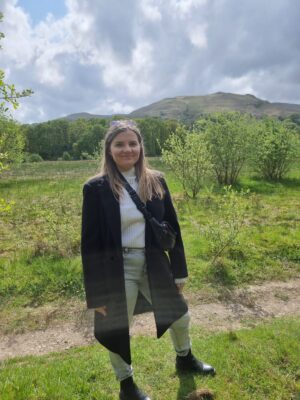
Author photograph (c) Henning Fritsch