
As the official English language media partner for the German Book Prize 2025, we are delighted to announce the shortlist of six outstanding books. We extend our heartfelt congratulations to all the shortlisted authors and their publishers.
The jury has shortlisted the following six novels for the German Book Prize 2025:

• Dorothee Elmiger: Die Holländerinnen (Carl Hanser Verlag, August 2025)
• Kaleb Erdmann: Die Ausweichschule (park x ullstein, July 2025)
• Jehona Kicaj: ë (Wallstein Verlag, July 2025)
• Thomas Melle: Haus zur Sonne (Verlag Kiepenheuer & Witsch, August 2025)
• Fiona Sironic: Am Samstag gehen die Mädchen in den Wald und jagen Sachen in die Luft (Ecco Verlag, March 2025)
• Christine Wunnicke: Wachs (Berenberg Verlag, March 2025)
We are especially thrilled to celebrate Die Holländerinnen by Dorothee Elmiger, which has been named the 2025 German Book Prize winner. More on the winning title and other shortlisted books follows below.

Dorothee Elmiger, Die Holländerinnen, Hanser
Read a sample translation by Jen Calleja here.
Jury comment:
Dorothee Elmiger’s novel recounts a collective transgression somewhere in the South American rainforest, largely in the mode of indirect speech. An unnamed director invites artists, among them the narrator, to a monstrous theatre project at a resort “between the tropics”. Together they are to trace the fate of two Dutch women who vanished there several years earlier under mysterious circumstances. Inevitably, the theatre-maker’s true-crime project spins out of control: the participants are almost swallowed by the jungle, drift into a mild form of madness and exchange disturbing stories from their past. An idiosyncratic, captivating journey into the heart of darkness.
Author Biography:
Dorothee Elmiger is a Swiss writer, editor and translator. She is the author of “Out of the Sugar Factory”, “Shift Sleepers” and “Invitation to the Bold of Heart”. Elmiger has been awarded numerous prizes, including the Aspekte Literature Prize for the best debut novel written in German, the 2021 Schillerpreis, and most recently the 2022 Nicolas Born Prize. “Out of the Sugar Factory” was shortlisted for both the German and the Swiss Book Award. She‘s a member of the German Academy for Language and Literature. She lives in New York.
Read our recommendation of Out of The Sugar Factory, which was published in English translation by Two Lines Press.
Foreign Rights: RCW Literary Agency
Laurence Laluyaux, Telephone +44 79 32 69 88
email: l.laluyaux@rcwlitagency.com

Kaleb Erdmann, Die Ausweichschule, park x ullstein
Read a sample translation by Rob Myatt here.
Jury comment:
Kaleb Erdmann was eleven years old when he lived through the school shooting in Erfurt. In “Die Ausweichschule”, he finds a literary way of addressing those events, without political agenda or sensationalism: searching, tentative, self-deprecating. The title refers both to the building to which the pupils were relocated at the time and, more broadly, to his own and the collective way of coping with what happened. Erdmann’s balance between distance and proximity to the shooting is linguistically convincing, as is his account of his search for the reliability of memory. The novel is also a story about writing itself, and about the question of how reality can be narrated. It is multi-layered and honest, and – despite the gravity of its subject – its tone is humorous, comical, and non-moralising.
Author Biography:
Kaleb Erdmann studied literary writing at the German Institute for Literature in Leipzig, as well as political science and theory in Munich and Frankfurt. He is at home on spoken-word stages and writes for various television and entertainment formats. His novel “we are pioneers” was awarded the prestigious Debut Prize at Lit Cologne Festival.
Foreign Rights: park x ullstein
Annemarie Blumenhagen, Telephone +49 30 23 45 64 50
email: rights@ullstein-buchverlage.de

Jehona Kicaj, ë, Wallstein
Read a sample translation by Eleanor Updegraff here.
Jury comment:
In “ë”, Jehona Kicaj tells the story of a young woman who flees to Germany with her family shortly before the outbreak of the Kosovo War in 1998. Starting from a jaw disease that afflicts the narrator – which can lead to speechlessness – she explores her Kosovar origins from the perspective of the diaspora on various narrative and temporal levels, including the ignorance and lack of knowledge of her German fellow citizens about her country. Through teeth and bones – which, as we learn, can also serve to identify murder victims – she retraces her fragmented history. An extraordinary novel which, starting from a grinding jaw and the small, identity-shaping letter “ë” in Albanian, opens up a multi-layered world and makes it tangible.
Author Biography:
Jehona Kicaj, born in Kosovo in 1991 and raised in Göttingen, studied Philosophy, German Studies and Modern German Literature in Hanover. After academic publications, she has also been publishing literary texts since 2020. She is co-editor of the anthology ‘“Und so blieb man eben für immer.” Gastarbeiter:innen und ihre Kinder’ (2023). The novel “ë” is her debut.
Foreign Rights: Wallstein
Lena Hartmann, Telephone +49 551 5 48 98 14
email: rights@wallstein-verlag.de

Thomas Melle, Haus zur Sonne, Kiepenheuer & Witsch
Read a sample translation by Adrian Nathan West here.
Jury comment:
Thomas Melle tells of extremely high flights, devastating landings and the irrepressible desire to leave one’s own life behind. His novel leads us into the abyss and into a bizarre wish-fulfilment clinic called “Haus zur Sonne”. The first person narrator, who suffers from severe bipolar disorder, checks in there to end his life. “Haus zur Sonne” stands in the long tradition of great suicide novels, from Hermann Hesse to Sylvia Plath to David Foster Wallace. Yet Melle forges his own path, giving the story a fantastic and comical twist. With “Haus zur Sonne”, he continues the self exploration he began so triumphantly with “Die Welt im Rücken”, creating a world that is as dystopian as it is utopian.
Read our recommendation – a New Books in German jury pick.
Author Biography:
Thomas Melle, born in 1975, studied comparative literature and philosophy. He is the author of widely performed plays and has translated William T. Vollmann and Quentin Tarantino (among others) into German. His debut novel “Sickster” (2011) was nominated for the German Book Prize and received the Franz Hessel Prize for Contemporary Literature. He followed it up with the novels “3000 Euro” (2014) and “Die Welt im Rücken” in 2016, both of which were shortlisted for the German Book Prize. The World at My Back has been translated into 22 languages.
Foreign Rights: Kiepenheuer & Witsch
Aleksandra Erakovic, Telephone +49 221 3 76 85 56
email: aerakovic@kiwi-verlag.de

Fiona Sironic, Am Samstag gehen die Mädchen in den Wald und jagen Sachen in die Luft, Ecco
Read a sample translation by Fiona Sironic here.
Jury comment:
“Am Samstag gehen die Mädchen in den Wald und jagen Sachen in die Luft” – the longest title in this year’s selection, and the most fast-paced novel. In her debut, Fiona Sironic tells the story of young people who live with the sense that time is running out. Species are dying out, nature is burning, the internet dictates the rhythm of communication. The girls, whose love story drives the novel, are in double rebellion: against the destruction of the world through ecological exploitation and through “mumfluencers”. Their anger is aimed both at the immediate future and at the takeover of their everyday lives by social media. Restless, inventive, confrontational and comic, this book – with its presence of mind – keeps us on edge right to the last page.
Author Biography:
Fiona Sironic, born in 1995 in Neuss, studied Language Arts, Creative Writing and Gender Studies in Hildesheim and Vienna, where she now lives as a freelance writer. She also gives workshops and focusses on digital games in her journalistic writing. Sironic has received various prizes, scholarships and nominations for her literary texts. For example, she was nominated for the Wortmeldungen Förderpreis, won the Open Mike 2019 and received both the BMKÖS working and starting scholarship.
Foreign Rights: Ecco
Julia Womser
email: julia.womser@harpercollins.de

Christine Wunnicke, Wachs, Berenberg
Read a sample translation by Philip Boehm here.
Jury comment:
An astonishing historical novel: in Paris during the Ancien Régime, thirteen-year-old Marie Biheron searches for corpses. She wants to become an anatomist, to understand how the parts relate to the whole – and perhaps even how the brain relates to the soul. Wunnicke reconstructs the eccentric life of a forgotten figure. Marie becomes famous for the wax models she fashions from the organs she dissects, having learned much from the older botanical illustrator Madeleine Basseporte. The book tells the lifelong love story of two women who sought dialogue with the great men of their age, from Diderot to Linnaeus. Undeterred – like Marie with her scalpel and Madeleine with her brush – Wunnicke spins a fascinating tale: witty, whimsical, and entertaining.
Author Biography:
Christine Wunnicke, born in 1966, lives in Munich and Berlin. She has been awarded the Jean Paul Prize, the Wilhelm Raabe Literature Prize, the Literature Prize of the City of Munich, the Tukan Prize, and the Franz Hessel Prize, among others. Berenberg has been publishing her novellas and novels since 2013, among them “Der Fuchs und Dr. Shimamura” (2015) and “Die Dame mit der bemalten Hand” (2020), which was shortlisted for the German Book Prize, as well as her selection and translation of Margherita Costa‘s work (2023).
Read our recommendations of Wunnicke’s previous work ‘The Lady With The Painted Hand’
Foreign Rights: Berenberg
Beatrice Faßbender, Telephone +49 30 21 91 63 60
email: bf@berenberg-verlag.de
It’s no coincidence that the 2025 shortlist peers into psychological, social and political abysses: whether tentatively, meditatively, with humour or with radicalism, the works are always deeply literary. As different as their narrative voices and styles may be, the novels seem to converse with one another – around themes such as violence, but also tenderness. In Kicaj’s novel, war crimes still grind between people’s teeth decades later; in Erdmann’s, a shooting spree alters the psychology of an entire city; and Melle’s manic literary ride asks how self-determined modern humans really are. Sironic tackles the deepening climate crisis with both verve and love, while Wunnicke follows two women in pre revolutionary France who flout every convention, and Elmiger paints the darkness
jury spokesperson Laura de Weck (Schweizer Radio und
that closes in when women suddenly disappear. Sound bleak? Not at all. Every book
on this shortlist is a liberating experience.
Fernsehen)
You can see the longlist of all twenty nominated books, many with sample translations in English, here.
Learn more by reading our interview with the prize organisers here.
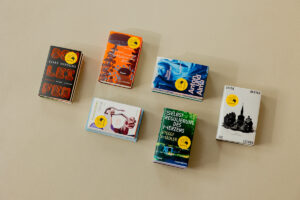
Photograph of shortlisted books (c) Christof Jakob.