
Sheridan Marshall talks to Prototype’s Jess Chandler and Astrid Alben about publishing beautiful books in translation.
Sheridan Marshall: Prototype was founded in 2019. Can you tell us how it all began?
Jess Chandler (JC): Prototype grew out of Test Centre, a small indie publishing project which I co-ran with Will Shutes from 2011 to 2018. Our output ranged from spoken-word vinyl LPs to debut poetry collections, experimental fiction, anthologies, interdisciplinary projects and an annual magazine of new writing. When this came to an end, I decided to start Prototype on my own, to build on the Test Centre aesthetic but with a greater focus on fiction, and with the ambition of making it more commercially viable and sustainable. My commitment to discovering formally experimental, hybrid writing remained, as did the focus on design and the book as object. Most importantly, perhaps, was my interest in offering a home for writers whose work is overlooked by mainstream literary publishers.
How do you balance aesthetic innovation – Prototype’s focus on ‘unique and beautiful books’ – with editorial integrity?
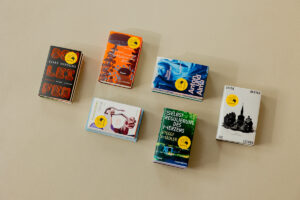
JC: For Prototype, form and content are inseparable, and the aesthetic presentation of a book should never interfere with the text. We value quality – in terms of style, material and printed form – and simplicity, ensuring this never distracts from the reading experience; it should only ever enhance it. We have a series design for our prose titles, which is a way of building trust with readers; the recognisable design (a single, changing block of colour above a single block of white, with consistent typography) should, over time, draw people to our books without requiring any prior knowledge of the author of that book. It’s also designed to be a collectible series, and the titles look very striking as a set, which keeps growing. I think it’s absolutely possible to focus on something being ‘beautiful’ without compromising or interfering with editorial integrity; rather, I think the two things work together and strengthen each other.
Prototype is organised into four ‘types’: poetry, prose, interdisciplinary projects, and anthologies. What excites you about interdisciplinary literature and how does this guide editorial decisions?
JC: Our interest in interdisciplinary literature has in many ways formed in response to the work we receive and have now become associated with. Because there aren’t that many publishers that specialise in this in-between space, we’ve found a lot of artists and writers coming to us with projects that might not easily be placed elsewhere. So, over time, we’ve really established this as a central aspect of what we do, and a reason for existing. As an independent publisher, I think it’s very important to find your niche – something that gives you a purpose and an identity – and for us, an interest in hybrid, interdisciplinary and collaborative work is one of our defining qualities, and strengths. In terms of how this guides our editorial decisions, it allows us a great deal of freedom, and an ability to take risks on works that don’t easily sit within a single genre. By establishing this approach over time, it becomes less of a risk, and something, instead, that we are sought out for.
You have said in a previous interview with Opt Indie Books that simplicity in design stands out amid over-designed books. How has this philosophy shaped Prototype’s visual identity?
JC: If you walk into a bookshop, you’ll be greeted with beautiful table displays filled with eye-catching but often extremely elaborate or image-based cover designs. Many of these covers are striking and draw you in, but there’s also something indistinguishable about them; it can be slightly overwhelming. Apart from a few publishing houses with very well-established aesthetics, many of them built up over decades, it’s hard to distinguish one publisher from another by the design of their books. As indie publishers, building a loyal readership is vital, as that trust is what allows us to be bold and take risks in the work we publish, and to do this, it’s vital that our books can be identified. It’s not just coincidence that more and more indie publishers are choosing series designs. I think it’s often the simpler designs that catch your eye in a bookshop now, because they are so different to the majority of commercially published books. I think we’re already starting to see the bigger publishing houses starting to follow suit. There’s also, crucially, another aspect to the simplicity, which is a kind of utilitarian, functional approach; freed of the need to spend lots of time and money – two things which indie publishers don’t have nearly enough of – on a new cover design for every title, we can put our resources into other things which, for us, are more important. So that practical necessity becomes part of the aesthetic.
Prototype books are praised for their aesthetics. How closely do you work with designers to realise each unique vision?
JC: We have a different approach to the design of our fiction books, which follow a series design where only the colour changes, and our other books, particularly poetry, where we approach each book as a unique thing which needs its own form and aesthetic. Poetry is such a visual form and takes such different shapes – literally – and were we to have no flexibility in the design of each book, I think we’d be compromising something, which might be detrimental to the work. For each book outside of our fiction series, we involve the author very closely in the design process at the start, asking them for as much input as possible before we hand over to our trusted designers, who we then like to give as much creative freedom as possible, based on the ideas we’ve shared with them. All of our poetry and interdisciplinary books look completely different to one another. Each book is its own collaborative project. I realise this contradicts my answer to the previous questions, where I talked about the importance of establishing a recognisable aesthetic, but I think that over time this variety has become the aesthetic, and I do think that our books feel and look like Prototype books, even though they’re so different. Although it might be a smarter move to bring everything into a series design, maintaining this flexibility feels really important to me, and is something that a lot of the writers we publish really care about, and sometimes a decisive factor in their choosing to publish with us.
What inspired the Prototype Development Programme, and how does it reflect your commitment to nurturing emerging voices?
JC: The Prototype Development Programme was funded by Arts Council England and formed part of a wider project focused on multidisciplinary and hybrid-genre approaches to writing, centred around a new prize which ran alongside it. As a publisher committed to providing a home for hybrid works that often resist definition, we have first-hand experience of the challenges of supporting writing that sits between traditional publishing categories. We felt there was a distinct lack of opportunities for writers and artists working in this way, and this programme aimed to fill that gap. The programme was open to applicants anywhere in the UK, who had not yet had a book-length publication or solo exhibition, with three of the eight places ringfenced for writers based in the North of England. The purpose of the programme was to offer an extended and focused period of support to emerging writers and artists who might not have the opportunity to access this kind of creative and career development. The programme received over 500 applications, and the quality of work was outstanding. By the end of the programme, three of the writers had agents, two had signed book deals, and all of them will, I’m sure, go on to publish their work. For us, it was an amazing opportunity to discover new writers, to widen our networks, and to really commit time and resources to supporting people’s work and opening up publication opportunities.
How else do you discover new voices, and what qualities do you look for in a new project?
‘We are interested in writing that pushes formal boundaries, but we are also, simply, drawn to work that we can’t put down, work that we feel drawn in by and want to immediately share with other people.’
Jess Chandler
JC: From a practical perspective, our authors come to us through a few different routes: some through open submissions windows, some through literary agents, some through submitting to our annual anthology, and others by us approaching them. We don’t just sit and wait for things to come to us but are active in forming relationships with writers we admire. Those relationships are absolutely crucial, building trust and long-term support and encouragement. In terms of taste and the qualities we look for, there’s inevitably a subjectivity to this process, and ultimately, we have to feel excited and moved by each manuscript we decide to take on. We are interested in writing that pushes formal boundaries, but we are also, simply, drawn to work that we can’t put down, work that we feel drawn in by and want to immediately share with other people.
What approach does Prototype take to publishing literature in translation?
Astrid Alben (AA): Prototype began publishing literature in translation in 2021, and this strand of our output has quickly become central to our programme. Our first translated title was Deceit by Yuri Felsen (trans. Bryan Kretnyk). Since then, we have published seven titles in translation, including works by Anne Vegter, Sasja Jansen, Carmen Pellegrino, Cecile Lind, Zsuzsanna Gahse, and Lina Scheynius, with four more titles planned for 2026–27.
Our approach is to integrate translations as a natural part of Prototype’s list, rather than treating them as a separate category. This enables us to build on our existing readership while introducing international voices. From the outset, we chose to focus on contemporary European literature, seeking works of both literary and aesthetic distinction that align with Prototype’s ethos.
The challenge for us, as a small independent publisher, lies in raising the UK profile of authors who are often well known in their own countries but little-read here. To meet this, we view publishing as extending beyond the book itself: our work includes carefully designed events programmes, strong relationships with independent booksellers, and targeted online promotion. This diversified strategy allows us to connect new audiences with translated literature while avoiding over-reliance on traditional bookshop sales alone.
Our books are distinguished not only by the quality of their writing and translation, but also by Prototype’s consistent visual identity and commitment to experimental, cross-disciplinary publishing. These elements strengthen the impact of each title, supporting our broader aim of presenting translation as an integral and dynamic part of contemporary literature in the UK.
What drew you to publish Mountainish? How does its fragmentary, diary-like structure align with your broader editorial vision for experimental prose?
AA: I was looking for a title that would be both exciting and innovative for an English readership, in terms of content and style. Gabriela Stöckli from Übersetzerhaus Looren suggested I read Mountainish (Bergisch teils farblos) by Zsuzsanna Gahse, and I loved it immediately. This genre-defying, humorous yet moving novel – composed of splinter-like stories and observations – fits perfectly with Prototype’s remit to publish ambitious, brilliant, and distinctive contemporary voices from across Europe.
Structured in 515 fragmentary notes, Mountainish offers a shifting interplay between six central characters, while at the same time building a vivid panorama of mountain landscapes and a multi-layered typology of all things ’mountainish’. Its diary-like, fragmentary form exemplifies the kind of experimental prose we are drawn to at Prototype: writing that questions established narrative structures, invites cross-disciplinary ways of reading, and pushes the boundaries of what the novel can be. This balance of innovation and accessibility is central to our broader editorial vision and makes Mountainish a natural addition to our list.
Katy Derbyshire’s translation of Mountainish has been praised as ‘clear as air at 15,000 feet’ by Nancy Campbell. What was it like collaborating with Katy on this text?
I always like it when translators pitch directly to us — they are often the best advocates for a book, sometimes knowing it more closely than the author does. Mountainish, however, came to us without a translator, so Jess and I needed to commission one.
Zsuzsanna Gahse’s oeuvre is marked by playfulness with language, humour, and a sharp observation of social phenomena. Her voice is confident, witty, and precise — qualities that demand a translator who can move effortlessly between linguistic agility and clarity. From the start, Katy Derbyshire felt like the natural choice.
Katy Derbyshire has an extraordinary ear for tone and rhythm, and she brings a rare sensitivity to humour and wordplay. She is also wonderfully collaborative: open, attentive, and generous with her insights. Working with her never felt like a straightforward ‘handover’ of text’ – it was more like a conversation, in which Katy’s skill and creativity constantly illuminated Gahse’s intricate prose.
The result is a translation that is, as Nancy Campbell so beautifully put it, ’clear as air at 15,000 feet.’ Katy has rendered Mountainish in English with precision and lightness, preserving both its wit and its depth, and working with her was as rewarding as seeing the final book come to life.
Can you tell us about some of your other recent publications – what should we be reading from Prototype this autumn?!
JC: We recently published Jen Calleja’s hybrid memoir Fair: The Life-Art of Translation, which you so kindly covered on your blog. The book is a satirical, refreshing and brilliantly playful book about learning the art of translation, being a bookworker in the publishing industry, growing up, family, and class. Loosely set in an imagined book fair/art fair/fun fair, in which every stall or ride imitates a real-world scenario or dilemma which must be observed and negotiated, the book moves between personal memories and larger questions about the role of the literary translator in publishing, about fairness and hard work, about the ways we define success, and what it means – and whether it is possible – to make a living as an artist. We can’t recommend it highly enough! Kate Briggs has said the book is: ’Essential reading for anyone interested in translation, translations and the working conditions of those who write them.’
AA: Yes, and there’s Girlbeast, a fast-paced, fearless and poetic reimagining of the Lolita narrative by Cecile Lind. Highly acclaimed in Denmark, where it is being adapted to the big screen, the novel confronts a world that fetishises girlhood with a daring examination of female agency, sexuality, and the complexities of consent. Girlbeast evokes the idea of the girl as animal – a creature conditioned to be both docile pet and wild beast, torn between submission and rebellion, innocence and desire.
It’s thrilling to see readers’ excitement and praise for the book on social media. Brave, provocative, and unflinching, Girlbeast is a gripping read. It’s a vital novel for our times and one everyone should be reading!
How do you navigate the tension between being experimental and sustaining a financially viable small press?
JC: This is the biggest challenge we face, and is a challenge faced by so many independent publishers, even when the work they publish is more commercial. I often try to avoid using the word ‘experimental’ when describing Prototype, as I feel it suggests a sort of difficulty or inaccessibility which really doesn’t capture the kind of work we’re interested in. You can experiment with form but still write something that has widespread appeal. In fact, sometimes being freed from the rules of a particular genre, allows writers to produce something that’s easier to relate to. I believe that our books have the potential for – and often reach – a wide readership, and we only ever take books on which we believe will have a wide enough appeal. It’s also important to remember that more commercial books and authors are mostly out of reach for us, as we simply can’t compete with the advances of bigger publishing houses. So, we have to keep publishing the work we believe in, which often goes on to do very well. The greatest challenge in terms of finances is the constantly growing costs that we have to cover to survive within the wider publishing industry, from rising print costs to huge distribution costs, decreasing review coverage, the data-driven and risk-averse retail landscape, and the small capacity of our teams. So, I don’t believe that it’s our interest in experimental work that puts our financial viability at risk.
How do you approach marketing interdisciplinary texts beyond literary circles?
JC: Perhaps a crucial aspect here is not to market our work as ‘experimental’, but rather to find ways of describing what the work is doing, and why this makes it compelling and exciting to read. Good experimental writing isn’t just experimental for the sake of it but is playing with forms and ideas for a reason, to communicate something which requires this experimentation, and this is what the focus should be on when describing that work. Over time, marketing the work is also built on a foundation of trust, and on a hope that all of the books on our list share certain qualities, and readers who’ve enjoyed previous books will want to read more, and over time the readership grows.
You have launched a bi-annual prize for interdisciplinary writers, the Prototype Prize. How will this shape your future publishing landscape?
JC: At the moment, we are trying to secure funding to run the prize again, which I hope we will. We hope that the prize will become a regular part of our publishing schedule, allowing us to find exceptional work, and to properly support authors – both financially and creatively – and give their work the visibility it deserves.
Looking ahead, how do you envision Prototype evolving over the next five years?
JC: The financial climate for independent publishers is harder than ever at the moment, with costs rising in every single area of the industry, and funding opportunities more limited than ever. Securing our future is crucial, and this is our current focus. We hope to get to a position where we can grow our team, so that we have the expertise and capacity we need to continue to publish work we believe in, and to do so in a way that is sustainable and fair for everyone involved.
Biographies:

Jess Chandler: Publisher
Jess Chandler founded Prototype in 2019. She was a co-founder of Test Centre, which ran from 2011 to 2018, publishing innovative works of poetry and fiction. She also co-runs, with Gareth Evans, the imprint House Sparrow Press. She has worked as an editor at Reaktion Books and used to work as a researcher and producer on factual television programmes. She was the Digital Editor of Poetry London for six years. Jess has extensive experience editing and publishing a range of books, from fiction and poetry to illustrated art books, literary biography, history and philosophy, specialising in poetry and hybrid, multidisciplinary works. Jess has been invited to give talks and seminars at institutions including Glasgow School of Art, Birkbeck and the Royal College of Art, and has been a tutor at the Poetry School. She is also a cellist, and lives in London with her partner and their two young children.

Astrid Alben: Commissioning Editor for Literature in Translation
Astrid Alben is a poet, translator and editor, and joined Prototype as Commissioning Editor for Literature in Translation in November 2021. Before joining Prototype, Astrid worked as CEO of the Poetry Translation Centre and was artistic director of PARS, an arts and sciences organisation she co-founded at the Rijksakademie voor beeldende kunsten in Amsterdam. The anthologies she edited on light, elasticity, and ice are published by Lars Müller Publishers. Astrid has worked as a curator for Parsons School of Design in New York and before that she was head of production at Saatchi & Saatchi Amsterdam. Astrid was awarded a Wellcome Trust Fellowship for her pioneering work across the arts and sciences in 2014. She is a Clore Fellow and the chair of Poetry London. Her work is widely published, including in the TLS, Granta and by Prototype.
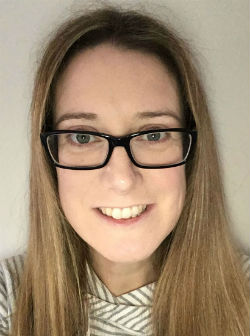
Sheridan Marshall is the Editorial Consultant at New Books in German. She works as a freelance literary editor and translator.