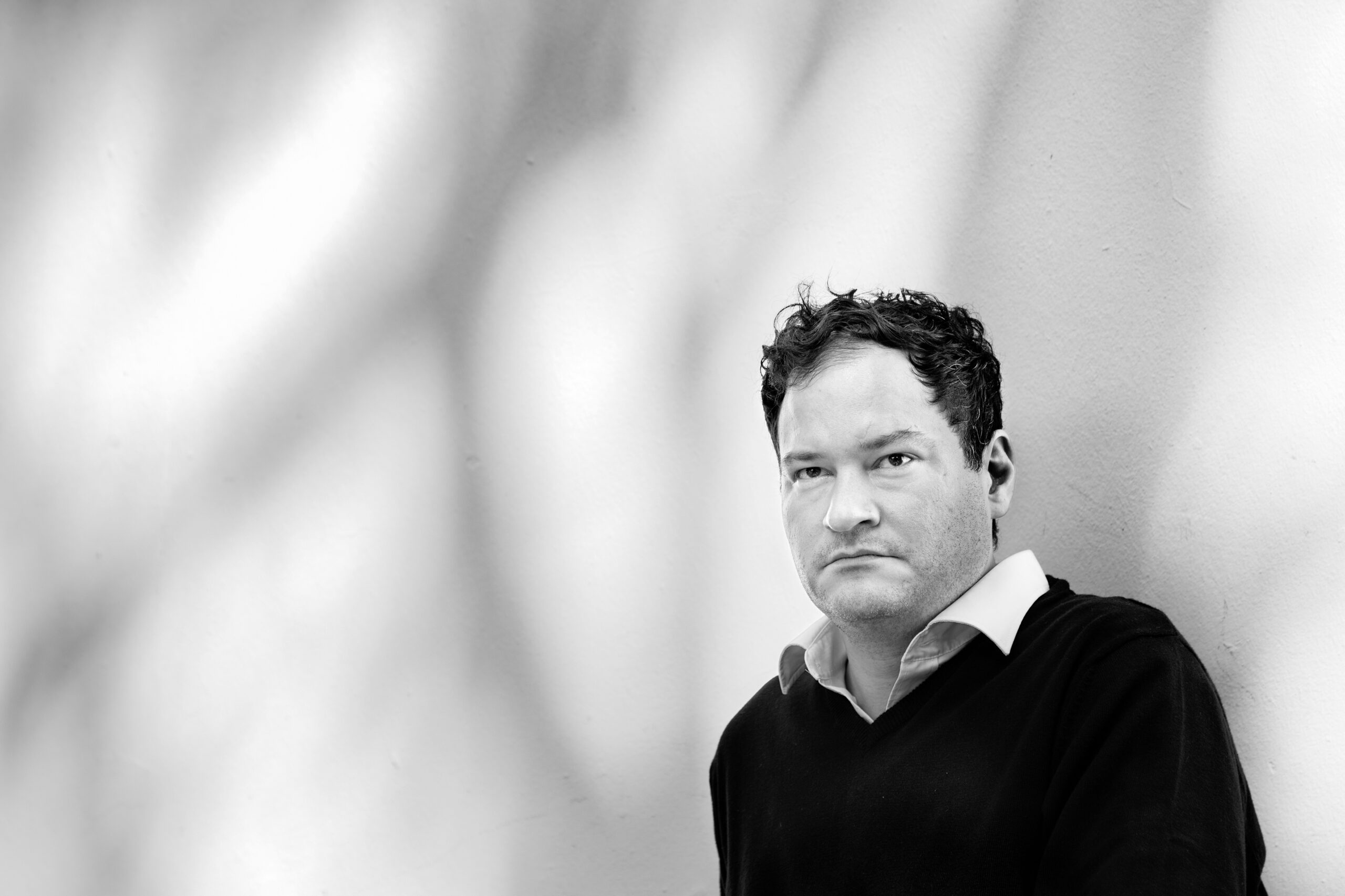
Thomas Melle, born in 1975 in Bonn, has established himself as one of the most incisive and stylistically daring voices in contemporary German literature. His work – including novels, essays, plays and literary translations from English – is marked by a fierce intellectual curiosity and an unflinching engagement with the psychological and social tensions that define modern life.
Melle studied Comparative Literature and Philosophy at the Eberhard Karls University in Tübingen, before continuing his academic journey at the University of Texas at Austin and later at the Free University of Berlin. His interdisciplinary, international education is reflected throughout his writing, with its philosophical foundations, literary sensibility, and keen awareness of global cultural discourse.
Before achieving widespread public recognition as a novelist, Melle made his name as a playwright and essayist. Several of his plays have been staged at major German theatres and have been acclaimed for their psychological acuity and the way they confront the contradictions of contemporary society. His writing for the stage often examines fractured identities, systems of power, and the absurdities of modern communication, which are recurring themes throughout his body of work.
Melle has often spoken about the formative impact of Anglo-American literature on his development as a writer, and his translation work represents an extension of his engagement with literature as a global, ever-evolving conversation.
Melle is also an accomplished translator. He has translated the works of several notable English-language authors into German, including William T. Vollmann and Tom McCarthy, writers whose experimental approaches and intellectual restlessness share an affinity with Melle’s own aesthetic concerns. Melle has often spoken about the formative impact of Anglo-American literature on his development as a writer, and his translation work represents an extension of his engagement with literature as a global, ever-evolving conversation.
His first major publication, the short-story collection Raumforderung (‘Mass’, 2007), received the prestigious Bremen Literature Prize for merging talent. The book announced Melle as a bold new voice – one capable of combining formal experimentation with a sensitivity to the tensions beneath the surface of everyday life. Critics praised the collection for its subtlety, linguistic originality and psychological insight, qualities that would come to define his novels as well.
Melle’s debut novel, Sickster (2011), marked a significant breakthrough. A darkly humorous yet deeply humane portrait of young adults adrift in a culture defined by excess, disconnection and self-invention, the novel was nominated for the German Book Prize and awarded the Franz Hessel Prize. Sickster introduced many readers to Melle’s distinctive narrative voice: one that is both analytical and emotional, satirical yet compassionate, and capable of moving effortlessly between the intimate and the sociopolitical.
His second novel, 3000 Euro (2014), further cemented his reputation as a chronicler of the precarious conditions of contemporary life. The book tells the intertwining stories of individuals living at the margins of an increasingly unequal society, capturing the unspoken despair and quiet resilience of those left behind by Germany’s economic boom. It was shortlisted for the German Book Prize and earned Melle the Berlin Art Prize in 2015. Reviewers celebrated the novel’s ability to depict systemic injustice without resorting to didacticism, as well as its nuanced portrayal of characters caught between hope and disillusionment.
In 2016, Melle published what is perhaps his most personal and widely discussed work: Die Welt im Rücken (translated by Luise von Flotow as The World at My Back, 2023), a profoundly moving account of his experiences living with bipolar disorder. Blending autobiographical testimony with literary craft, the book confronts the destabilising force of the illness with remarkable honesty, clarity, and imaginative skill. It was again shortlisted for the German Book Prize and received the Klopstock Prize for Contemporary Literature. The work has been praised not only as an important contribution to destigmatising mental illness, but also as a major literary achievement in its own right: an attempt to translate the unrepresentable states of manic and depressive extremes into language.
Beyond his published works, Melle has contributed essays, lectures and cultural criticism to numerous German newspapers and literary magazines. His reflections on mental health, the pressures of performance culture, the transformation of urban life and the relationship between literature and society have made him an important voice in contemporary debates about the role of art in a rapidly changing world.
Melle’s contributions have been recognised with several residencies, fellowships, and literary honours. Notably, he served as the Stadtschreiber von Bergen (‘writer-in-residence in Bergen’) in 2017/18, a position that offered him the opportunity to develop new ideas while engaging directly with readers and local cultural institutions.

Melle’s latest novel, Haus zur Sonne (‘House in the Sun’), shortlisted for the 2025 German Book Prize and recommended by New Books in German, confirms his position as one of the most fearless and innovative writers in the German-speaking world.
Whether exploring the fractures of contemporary capitalism, the intricacies of human relationships or the turbulent landscapes of the mind, Thomas Melle consistently challenges readers to confront the uncomfortable truths of modern existence, while reminding them, too, of the fragile beauty and strange humour that persist within it.
Congratulations on your wonderful new novel, Haus zur Sonne. Could you tell us how you came to write it?
Thank you! I had the basic idea very early on, in 2006, and at the time I used it in a play set entirely in a thermal bath. Then, in 2015, I wanted to develop this idea into a novel, but the protagonist mostly talked about his bipolar disorder – there must have been a great urge to explain things – and so it became Die Welt im Rücken, a book that deals solely with my illness. Now, in recent years, the time finally felt right, and I was able to develop the idea properly and at length.
Despite his dark subject matter, Melle never fails to inject his writing with humour, turning his gaze on modern society and discussing digital and social media, digital surveillance and virtual reality.
From the NBG recommendation of Haus zur Sonne
How did you come up with the idea of the clinic – the eponymous “House in the Sun”?
I believe (as I said, it was a long time ago) that I wondered why suicide always has to be so lonely, miserable, and sometimes brutal. And whether those in real despair should not be offered some kind of alternative – whether in a utopia or a dystopia, which, for me at the time, were not clearly distinguishable. I thought the concept had something both seductive and dangerous about it, which made it an intriguing idea.
Your novel moves between a wellness oasis and a highly technologised institute for dying. What appealed to you about creating a place that offers both the illusion of healing and the possibility of a “gentle disappearance”?
There is no promise of healing – only the opportunity to savour life once more without limits, or to play through alternative versions of one’s own life. Isn’t it likely that the “clients” might experience more, and have a better time, during this brief stay than they ever did in their “normal” lives? But does that justify such a fatal bargain? All these questions cut both ways, and that’s what I found so fascinating.
The narrator constantly oscillates between autonomy and total dependence on the system of the House. What questions did you want to raise about self-determination, manipulation, and consent?
It is never quite clear when care turns into coercion, particularly when the state is involved. That is generally the case, and it is certainly true in psychiatry; these boundaries are not easily drawn, and one is constantly operating within grey areas. But my narrator gives up his autonomy the moment he enters the clinic, and at first this is liberating for him. Then he undergoes a development and becomes aware of his inner autonomy once again.
Amid the grotesque or disturbing moments, there are also surprisingly tender, human encounters. How important was this balance between existential darkness and everyday warmth to you?
Very important, and this protagonist is someone who longs for warmth and to blend in with other people. What becomes unsettling is that, at some point, he can no longer be sure how far the simulations and performances extend – who is employed by the clinic and who is not. But yes: darkness needs contrast. Some readers now even say the book is “a hymn to life.” I’m not entirely convinced, but I’m very open to such interpretations.
The House in the Sun offers its clients the chance to realise their deepest wishes, even if these are destructive. Were you intending to comment on the commercialisation of care, mental health, and human needs?
No and yes. I believe that the “House in the Sun” is ultimately a logical further development of the welfare state. Now even dying is being administered and optimised. Is that good, is that bad? The book offers a shimmering, multifaceted answer.
What was it like to write this book, which is at once autobiographical, dystopian, and satirical? Did the writing have a therapeutic effect?
No, it certainly had no such effect.
Could you tell us something about how your writing style has changed over the course of your career?
I believe the language still sparkles and glows, but it no longer needs to set off constant fireworks.
Thomas Melle
Yes, while I once tended towards shrill, expressive metaphors and a somewhat driven form of rhetoric, very much in the spirit of Sturm und Drang, which I also enjoyed firing up and celebrating, my style now is much more sober and matter-of-fact. I believe the language still sparkles and glows, but it no longer needs to set off constant fireworks.
As a close friend of someone living with a severe form of bipolar disorder, I found Haus zur Sonne particularly thought-provoking and moving. Have you received responses from readers who struggle with the same illness, and how have they reacted to the novel?
Not so many for this book yet, but an extraordinary number for Die Welt im Rücken. This illness – bipolar disorder – is still heavily stigmatised, and people are grateful when someone affected stands up personally and attempts to depict it using artistic means (which I almost consider necessary if one is to convey even an inkling of what these states of mind feel like). It is always an attempt to make the incomprehensible somehow comprehensible.
Haus zur Sonne was nominated for the inaugural SPIEGEL Book Prize 2025 and made the shortlist for the German Book Prize 2025. I believe this is your fourth novel to be nominated for the German Book Prize – an enormous achievement. How did it feel to be shortlisted again? How important are literary prizes to you as an author?
It was, of course, a pleasure. But sometimes I think I may not receive many more prizes. In the end, juries might find this proximity to an actual illness a little too unsettling.
We’re delighted that Haus zur Sonne is among the latest New Books in German recommendations, which means it is guaranteed to receive financial support from the Goethe-Institut for an English translation, provided a publisher can be found. What would it mean to you to have Haus zur Sonne translated into English?
It would mean a great deal to me. I work as a translator from English – or at least I used to – and I have been influenced by many authors from the English-speaking world. And also by the year I spent studying in Austin, Texas, in 1997. I would be absolutely delighted.
Could you tell us something about what you are working on at the moment?
I am attempting another autobiographical piece, one that considers the illness in its social context. To do this, I will also need to describe my most recent manic episode. And I must also address my origins. In short: the illness and society, causes and devastating consequences beyond the neurons, including structural reasons, and depression as a result of exclusion.
And finally: what is currently on your “to read” pile?
At the moment I’m reading Dostoevsky and – excuse me – listening to Thomas Mann as I fall asleep.
Thank you very much for your time and for sharing these insights with us.
With thanks to the Goethe-Institut London for their kind support of this interview.
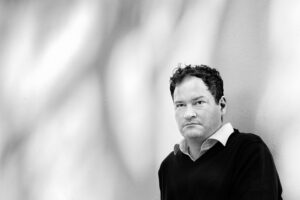
Thomas Melle photograph ©Regina Schmeken
Sheridan Marshall works as Editorial Consultant for New Books in German. She is a translator from German into English.