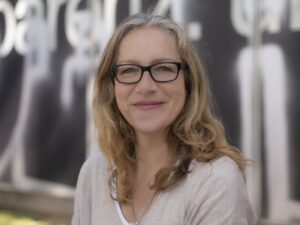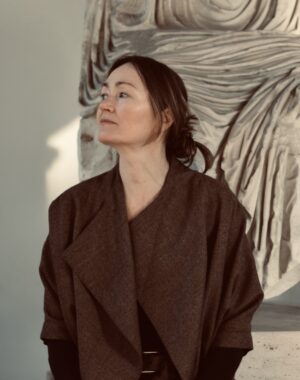

Independent literary scholar Dr Maha El Hissy speaks to NBG about her work and the Goethe-Institut’s ‘Accidental Portents’ project, which she curated in 2024
Anna Compton: It seems like your work is very varied – could you tell me a bit about your career so far?
Dr Maha El Hissy: In the past, I’ve worked at academic institutions in Germany, the US, the UK and Egypt. I then became an independent literary scholar in 2023. Since then I have also worked mainly as a curator and moderator, as well as a literary critic.
What subject areas do you specialise in as a literary scholar?
I specialise in German and non-German language literature in Germany, which I also consider to be part of the contemporary German literary scene. I mostly work on writing by marginalised authors, whether they write in German or in other languages I can read, usually Arabic, as well as post-colonial literatures.
What do you enjoy most about your work?
As an independent scholar, I enjoy having lots of freedom to choose what to focus on. I have so many opportunities to meet and work with different authors at every event, which is very enriching. As a curator, I very much enjoy the challenge of conceptualising my own event series, filling them with my own content and trying to work against established power structures where marginalised authors are not usually heard or seen. I’m not the only person who does that, or the first person to do that, but it gives me a chance to do it one more time and to contribute further to an increased focus on marginalised writing.
That sounds amazing! What are you working on at the moment?
Until recently I was in the US, teaching at Columbia University in New York as a visiting professor in the Department of Germanic Languages, focusing on marginalised authors. I’m now preparing for a podcast series together with the Goethe-Institut Ramallah and the Palestinian cultural platform Radio Atheer called ‘Ne7ki’, which is a transliteration of the Arabic word for ‘telling’. The number seven replaces a letter that sounds like ‘h’. This series with Palestinian writers in and outside Gaza is mainly about storytelling and keeping the narrative about Gaza going, but it also tries to create a space to hear more about the challenges authors in Gaza are facing in their work and writing under decades of artistic siege.
What are you reading? Are there any books you’ve read recently that you would particularly recommend?
Well, of course, I’ve been reading a lot of books by Palestinian writers. In German, I would recommend Der letzte Himmel: Meine Suche nach Palästina by Alena Jabarine, recently published by Ullstein. There’s also The Book of Disappearance by author Ibtisam Azem. The English translation was published in 2024 and has been longlisted for the International Booker Prize. It was also translated into German in 2023. And finally, there’s Gaza Writes Back, a collection of short stories written in English and edited by Refaat Alareer. As you can see, I’m a multitasking reader who reads several things at the same time!
Thanks for your recommendations! So, now I’d like to know more about the project you recently curated with the Goethe-Institut called ‘Vorzeichen’ (or ‘Accidental Portents’ in English). Could you briefly explain what it was about?
I saw that the Goethe-Institut Northern Europe was advertising for a curator to work against the canon, which was a great fit for me because I focus on writing by marginalised authors, which definitely includes working against the process of canonisation. ‘Accidental Portents’ was trying to shed light on reading as a means of dismantling power structures and to question how we read, as well as what and whom. In music, ‘Vorzeichen’ are the accidentals that change the frequency and lead to a new sound.
It was also important for me to highlight that the authors and speakers who were part of the project were intended to be suggestions – they were not meant to be a new canon. Its underlying aim was to create chaos among the established order in German literature that has shaped our way of looking at texts, bookshelves, readerships and even event halls, to always make sure that there is disruption or intervention. I hope I’ve given an example of how to create disruption, but it’s not the definitive one – everyone can decide for themselves how to do this.
Another aspect of ‘Accidental Portents’ was considering those for whom a text was not written, because certain groups of readers are marginalised too, by being excluded from the main target readership. So I was trying to come up with new ideas and questions for reading on this basis.
How did the project aim to change how we read?
The project promoted a dynamic form of reading – reading books together or against each other in a collaborative approach that encourages communication with others, or ‘co-reading’, where we can come up with new readings, shed light on different perspectives and recognise new things in texts that we weren’t previously aware of.
What kind of events were held?
There were eight ‘Meet the Author’ book club events, as well as six events with experts, scholars and translators both within and outside academia, mainly working at the intersection between universities and the public sphere. Recordings are available on the project’s website.
How did you choose the authors and books to feature?
That’s a very good question actually, because I thought a lot about my curatorial practice. My intention was to subvert expectations. As soon as I knew what people would most likely expect to see next, I would choose the exact opposite or go in a completely different direction. I worked against a commercial approach to literature and reading, which meant not always picking the most recently published books, instead going for books published a few years ago that didn’t receive as much attention as they should have, because they were by authors of colour and other marginalised authors in Germany. I also chose genres that don’t usually make it into the canon, such as slam poetry. I applied a mixture of all these aspects, and the most important one for me was to work against the grain and challenge myself to make different choices, not the most logical or obvious ones. That kept things very exciting.
Could you recommend some authors and works that were featured?
All of them! But I would particularly recommend Necati Öziri, who was the first author I invited to participate. There was a reason behind that, because he has a theatrical practice that targets canonisation. In the Meet the Author event, he spoke about how he tries to rewrite, retell and restage plays and texts to give minor characters, who perhaps didn’t say much, more major roles. By doing this, you hear narratives that you weren’t really aware of. There’s also the author Şeyda Kurt, whose book Hate: The Uses of a Powerful Emotion will be published in English translation by Verso Books in November 2025. In her book, Kurt writes about the power of hate as an anti-colonial practice, but also as an undesirable feeling that is usually pushed to the margins, yet can still dismantle power structures.
As for the lectures, I would recommend the talk by Jeanette Oholi, co-curated and co-hosted with Kyung-Ho Cha, in which she proposes bringing works by Black authors and authors of colour together in dialogue with traditional canonical works in German studies. In another lecture, co-curated and co-hosted with Anna von Rath, Ervin Malakaj spoke about changing our perspective to consider literature in Germany, not of Germany. I thought this approach was particularly important since right-wing extremism, which is on the rise in Germany and elsewhere, is taking us back to a nationalist form of thinking about literature, for instance, that it has to be German-language literature, and literature by white, male, heterosexual, cis authors. It is then an anti-fascist practice to focus on marginalised writing and voices – literature that is not necessarily in German or about Germany that often remains unseen. Finally, there’s the event with Thalia Ostendorf and Jon Cho-Polizzi called ‘Disrupting Translation, which I curated and hosted together with Leila Essa’. This centred around efforts to translate texts by Black authors, authors of colour and other marginalised writers and get them published. Jon Cho-Polizzi also translated the ‘Accidental Portents’ website and all the materials for the event series into English.
Now it’s over, what do you hope the legacy of ‘Accidental Portents’ might be?
Ideally it will continue – especially the disruption as an anti-fascist practice, for as long as there is fascism. I also hope that marginalised authors will receive more attention from publishing houses and funds for translation. I’m aware of the markets and their challenges, where bestsellers are the focus, but sometimes writing by marginalised authors creates new markets and can even have a larger market outside Germany.
Are you aware of any impact the project has had so far?
Interestingly, it has mostly had an impact in academic institutions. University lecturers have been sharing the links to the online lecture series and using these recorded events in their classes – asking their students to watch them when they don’t have the funding to invite the authors to speak in person. The project was also mentioned in a festival of Black literature in Germany called ‘Resonanzen’ (‘Resonances’), which aims to counteract the underrepresentation of Black fiction in the German literary canon.
That’s brilliant! And finally, what else do you think can be done to expand the canon of German literature?
The feedback I got from the project makes it clear that we need to continue somehow, because people were asking why the ‘Accidental Portents’ project was ending. They wanted to continue disrupting institutionalised practices in one way or another. One way I think would be effective would be to create disruption from within mainly white institutions by increasing the number of staff from marginalised communities to introduce a different gaze.
What kind of role can national cultural organisations like the Goethe-Institut play in shaping the literature we read?
They have an influence through the books they purchase, put on their shelves and include in their reading lists. Through this they have the power to introduce marginalised literatures to readers, people learning German and people who want to learn about Germany and German culture. They can prepare reading rooms and libraries as safe spaces for people of colour, queer and trans people, and any marginalised communities.
Thanks for taking the time to talk to me, Maha. It’s been really interesting!
Learn more about the Vorzeichen project here.
Links to all of the online lectures and Meet the Author sessions are here.
Dr Maha El Hissy photo credit: Lina Burcu

Maha El Hissy is an independent literary scholar, after having taught German and Comparative Literature at Queen Mary University of London, Ludwig-Maximilians University in Munich and the University of Cairo. El Hissy’s research and writing focus on migration, transcultural perspectives, writing by marginalised communities in Germany, literature and right-wing extremism, postcolonial theory and literatures. She is currently working on a collection of essays on erased Arab archives in Germany from 1970 to the present.

Anna Compton is a freelance translator working from German and French. She previously spent nine years as an in-house translator at a language service provider, where she ran translation internships and gave talks about translation as a career, as well as translating and revising a wide variety of texts.