For nearly a decade, the European Poetry Festival has been a major celebration of contemporary European poetry in the UK, bringing together over 1,000 poets through live collaborations and performances. The Festival has become a space for experimentation, exchange, and community across borders. Festival founder and director SJ Fowler was kind enough to share some thoughts with us in the run up to this year’s festival, which takes place June 17th to July 4th.
The festival is now in its ninth year (and over fifteen years as an events series) and features over 100 poets. How do you approach shaping the programme given such scope and diversity?
It’s a process with lots of intricacy, and really a lot of joy, as it’s fundamentally a product of my having ended up in a large milieu of poets and performers and artists and organisers over the last 15 plus years in the UK and throughout Europe. I am constantly investing in relationships with people, that’s the truth of it – I’m keen to know new people who are interested in what I’m interested in and I rely on friendships from previous festivals. This way venues are found, dates are aligned, invitations are made, research is done and it all coalesces, somehow, over a number of months. It’s normally 10 to 15 events in the summer, each with 12 to 16 poets, so hundreds of people involved. It’s about people, and their generosity, but also based on what they know we do.
I was struck by the breadth of partners involved in the festival, both international organisations as well as national initiatives. What does this suggest about the relevance and resonance of European poetry today?
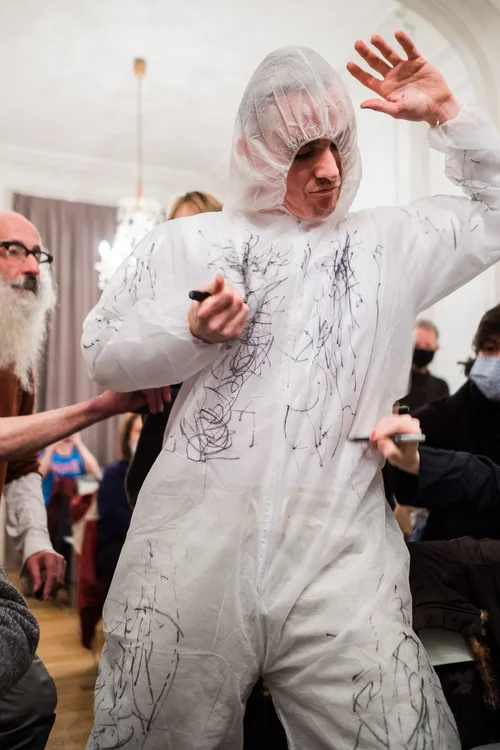
I’d be cautious to draw any wider conclusions on relevance, just as a mode. I believe the festival has been sustainable, psychologically or emotionally, shall we say, being run by one person, because I am not trying to create any utopian or over arching impact. I’m just trying to create singular evenings, where people create unusually dynamic collaborative live poetry in an environment where it is friendly, funny, hospitable and down to earth. I want to meet people, connect them and put literary and avant-garde poetry in an open space. European poetry carries such powerful traditions in this regard, so it all fits together. The volume of partners is due to their generosity? Their trust? And maybe our consistency? Or the energy of the thing? My desire to reach out? To make more of what we have? I hope so. It’d be lovely if this speaks to a resonance for European poetry here in the UK, but I think it’s not for me to say, but for me to do, if that makes sense. Naturally I personally believe fervently in the resonance of European poetry today.
The Austrian and Swiss celebrations both feature poets working in collaboration with British counterparts to present new work. What stands out to you about the poetry scenes in Austria and Switzerland, and what is distinctive about these collaborative exchanges?
Yes these are two of the fest’s most generous and consistent partners. They really believe in what we are doing and we’re grateful for that because it means audiences get to see what is happening in these two nations in the UK every year. Some audience members do follow the work of these poets after the events and they become a way into to things happening in these nations that might otherwise be opaque. I wouldn’t want to make generalisations about the scenes in these countries but I’ve found the poets I work with often are really affable as people while being very complex in their texts, and I would say it’s because the traditions are different than in the UK, and certainly ideas around modernism and language are more fundamental, and casual, and discussions are accessibility and readability are different. My work is more aligned with the scenes I’ve experienced in Austria and Switzerland and I am jealous the people who seem to win prizes in these countries are doing really intense, complex work. I could write 50 pages on this, but I’ve bored too many people too many times to do that. In addition I think performance and the tradition of experimentation in literature is more common.
Have you noticed changes in your audiences, or their reactions to the programme over time?
Not distinctly. I could say we had a surge of people after brexit but this is about numbers, and we’ve always been lucky in that regard, with our word of mouth model and great web of support, we’ve always been busy. What I am happy about, in the consistency of our audiences, is that every event has those who came along before along side those who are trying it for the first time. And you can tell they have not been to events like ours before if they are in the latter group. That what we do seems unique, and engaging, and serious, and playful, and intense, and communal. That they are included in a palpable sense, and they are watching new things, made for that night. So in that sense the change has only been that affirmation that what we are doing is worth doing as people of all ages, backgrounds, nations, languages, identities and ideas are coming to see it.
Read on!
An Overview of German-language Poetry – New Books in German New Books in German invited Professor Karen Leeder to give readers an introductory overview of contemporary poetry in German.
Where Poetry Meets the Novel: The Lyric Voices Shaping German Fiction – New Books in German This article by Sheridan Marshall highlights some of the poet-novelists we have featured recently – either because their books were selected by our jury, or because we highlighted their work elsewhere on our site – and considers the fruitful connections between their work in both literary genres