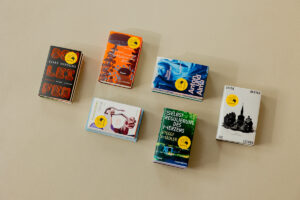

Over 40 million copies of German born, Mexican naturalised author B. Traven’s books have been sold around the world, with 1,500 editions in more than 40 languages. They have been adapted for film and TV since the breakthrough movie of Treasure of the Sierra Madre starring Humphrey Bogart, which won three Oscars in 1949. More recently, Traven´s first published book, Das Totenschiff (The Death Ship) (1926), was voted one of the top one hundred books written in German between 1924 and 2024 by a jury from Der Spiegel magazine in October 2024.
2026 will mark the 100th anniversary of the publication of Das Totenschiff (The Death Ship) by B. Traven (1882–1969). Penguin Classics will be publishing three of Traven’s works in English translation: The Death Ship, The Treasure of the Sierra Madre, and The Bridge in the Jungle. The first to appear will be The Death Ship in 2026.
We spoke to Tim Heyman, the Managing Director of B. Traven’s literary estate, about the author’s life and work.
Sarah Hemens: Thanks, Tim, for speaking to New Books in German. Could you tell us more about B. Traven?
Tim Heyman: Traven’s birth name was Moritz Rathenau. He used the pseudonym Ret Marut when he was living in Germany (1882 -1923), and then switched to the pseudonym of B. Traven during his time in Mexico (1924-1969). As the illegitimate son of a prominent industrialist (Emil Rathenau) and an Irish actress (Helen Mareck), he became an anarchist, and developed an abiding sympathy for the underprivileged poor, of all nationalities and races. He rejected his privileged background, and wrote books from the point of view of the underclass.
During his time in Germany as a merchant seaman, actor, director, journalist and politician, Traven wrote short stories and novellas covering many subjects. His first novels were completed after he arrived in Mexico and were published in 1926, when he was forty-four. They have the recurring theme of the plight of the oppressed against the oppressors, which are not only people but an entire system. His first five novels, published from 1926 to 1929, are also both European and autobiographical.
Traven was a publishing phenomenon in Germany, with over 500,000 copies of his books being sold by the end of the 1920s. Cumulatively, over 40 million copies of his books have been sold around the world, with 1,500 editions in more than 40 languages. They have been adapted for film and TV since the breakthrough movie of Treasure of the Sierra Madre starring Humphrey Bogart, which won three Oscars in 1949. More recently, Das Totenschiff (The Death Ship) (1926), was voted one of the top one hundred books written in German between 1924 and 2024 by a jury from Der Spiegel magazine in October 2024, in the company of titles by Thomas Mann and Franz Kafka.
Cumulatively, over 40 million copies of his books have been sold around the world, with 1,500 editions in more than 40 languages. They have been adapted for film and TV since the breakthrough movie of Treasure of the Sierra Madre starring Humphrey Bogart, which won three Oscars in 1949.
Tim Heyman
Can you tell us about your plans to highlight B. Traven’s work next year?
We have various activities planned. First is the republication of Traven’s works. We have already arranged this in German-speaking countries (with Diogenes), the US (Farrar Straus), Brazil (Quimera/Imprimatur), France (Libertalia), Italy (WOM Edizioni), Greece (Nautilus), Turkey (SEL*), and Mexico, Spain and Latin America (Penguin Random House). We have appointed the Tanja Howarth Literary Agency as agent of the B. Traven Estate. I actually asked AI for assistance in tracking Tanja down! Her experience is unrivalled. Our brief to Tanja was to find a strong publisher for the UK and we are delighted that Penguin Classics will publish three of the novels in English translation: The Death Ship, The Treasure of the Sierra Madre, and The Bridge in the Jungle. The first to appear will be The Death Ship in 2026. We also aim to cover key English-speaking countries such as Australia, New Zealand, and India, as well as Scandinavia and Eastern Europe.
The second activity is the production of two movies based on Traven works which are in a fairly advanced stage of development, as well as a documentary on Traven. And finally, we are planning a Traven exhibit for cities in both Germany and Mexico, reflecting Traven’s two nationalities, and, where possible, other countries as well.

London Summer 2025
What recurring themes or ideas do you see running through Traven’s major works?
Traven’s first two novels, Das Totenschiff (The Death Ship) and Die Baumwollpflücker (The Cotton-Pickers), both published in 1926, are about identity, migration and oppression. His third novel, Der Schatz der Sierra Madre (The Treasure of the Sierra Madre) (1927) is a thematic continuation of the previous two books. It focuses on a group of three jobless vagrants in Tampico who, having tried some of the jobs mentioned in The Cotton-Pickers, decide to go into business for themselves as treasure hunters in the Sierra Madre.
Traven’s fourth book, Land des Frühlings (‘Land of Springtime’), published in 1928, is not a novel, but an anthropological study of the Mexican state of Chiapas. Traven describes and analyses the state’s geography and topography, its governance, economy, social organisation, customs, and infrastructure. He realised that the oppression of the indigenous people of Chiapas was similar to that of workers in developed countries. His fourth novel Bridge in the Jungle (1929) is a product of the increasing sympathy for the culture of the indigenous Mexicans that he developed through his repeated visits to Chiapas. A few years later Traven novelised the exploitation of indigenous Mexican people, focussing on the mahogany logging camps in Chiapas in the epic, six-book Mahogany Cycle (1931-40).
His fifth novel Die Weiße Rose (The White Rose) (1929) is about the direct clash of cultures between an idyllic farming community the Hacienda Rosa Blanca led by Don Jacinto and the San Francisco based Condor Mining Company led by C. C. Collins, a prototypical capitalist. Traven’s final novel, Aslan Norval (1960), was written following a gap of twenty years after he finished the Mahogany Cycle, and reflects the passage of time and his own intellectual and personal development. Its protagonist is a young woman, Aslan, who develops a project to construct a canal across the United States to reduce its dependence on the Panama Canal, and provide employment in post-war 1950s United States.
With the common theme of exploitation, all of Traven’s novels are based on personal experience or meticulous and accurate reporting, something he constantly stressed to his publishers.
What relevance do you think Traven’s work holds today?
The issues of sovereignty, identity, migration, and race are now back at the forefront of political concerns between and within developed and developing countries, with the additional complication of the emergence of China and the reemergence of Russia. This makes Traven, almost exactly 100 years after his first appearance as a writer, even more relevant than ever.
Tim Heyman
Francis Fukuyama announced in The End of History and the Last Man (1992) that with the collapse of the Berlin Wall, the struggle between capitalism and communism was over. The postwar model structured through organisations such as the UN, the IMF, the World Bank and NATO would now be universally accepted. However, in the 21st century, globalisation has been accelerated by technological developments, with the greatest political and social change being brought about by the development of social media. The issues of sovereignty, identity, migration, and race are now back at the forefront of political concerns between and within developed and developing countries, with the additional complication of the emergence of China and the reemergence of Russia. This makes Traven, almost exactly 100 years after his first appearance as a writer, even more relevant than ever.
What is distinctive about Traven’s literary style?
Traven’s background and training as an actor and director mean he is able to fill his novels with strong characters, life and narrative.
Tim Heyman
Traven’s literary style can be summed up in six words: energy, passion, humour, irony, ingenuity, and engagement. While he found his vocation in Germany, he found his voice in Mexico. One might expect a novelist whose main themes were identity, migration, race and exploitation to be boring, but this is far from the case. Traven’s background and training as an actor and director mean he is able to fill his novels with strong characters, life and narrative.
How did you come to be involved with the Traven estate?
I became involved with Traven because in 1981 I married his stepdaughter, my wife Maria Eugenia (Malú) Montes de Oca Luján. She grew up with Traven, who married her mother Rosa Elena Lujàn in 1957, from a very young age until his death in 1969. So I have been surrounded by his presence and aware of his story for the last forty-four years. I became more fully involved with Traven after 2016 when there was the first major exhibition of his life, work and legacy at the Museum of Modern Art in Mexico City. As I explained Traven’s life and work to the people we invited to the exhibition, I realised how unique and remarkable he was as a person and a writer, and began to understand the reasons for his global recognition. I had been a student of language and literature, mainly the Classics, from childhood until my graduation from Oxford. I decided to devote most of my time after I finished my career in finance in 2020 to the further research of his life and work and join Malú in the process of reintroducing Traven to present and future generations. Since her mother died in 2009, Malú is the coproprietor of the Traven Estate with her niece and has been looking after it with her mother since the 1990s,.
The archive held by the Traven estate is vast. Your day-to-day work as a literary estate manager must involve many different tasks, both creative and administrative. Could you give us a flavour of your work?
It has been important to gain an understanding of Traven’s life and its relation to his work, which has entailed rereading his works, reading and organising the archive, and, most recently, discovering his parentage. Then, there is the process of republishing his books. This involves constant contact with our agent and with our eight existing publishers where we are coordinating their publishing programme with the 2026 anniversary and succeeding years. The two current movie projects involve working closely with the producers, including checking the scripts to make sure they reflect Traven’s intentions. There are also the financial, accounting, and tax aspects where my professional experience comes in useful.
We are planning to place the archive of the B. Traven Estate with an institution which would enable all those interested in researching Traven’s life, work, and legacy to access a unique and inexhaustible trove of information. The archive is currently being inventoried by an expert in these matters. It is divided into a number of categories: manuscripts and screenplays in three main languages (German, English and Spanish); personal and professional correspondence; books, articles and press cuttings in various languages about him; authors’ copies of his novels and stories in more than twenty languages, many of them marked up by Traven himself; Traven’s own collections of books by other authors, both fiction and non-fiction, also marked by the author; his personal belongings, including typewriters, cameras, clothes and other personal possession; more than 3,000 photographs which he took himself mainly in the 1920s and the 1930s on his expeditions to the jungle; portraits of him and works inspired by him by well-known artists of many nationalities.
Do you have a favourite item in the archive? Why is it your favourite?
My favourite items in the archive are the items that were not shown to biographers to protect Traven’s privacy. These include his letters to Malú and her sister when they were growing up and his love letters both to my mother-in-law, his only wife, and to the girlfriends he knew when he was younger. They show a playful, tender, romantic, passionate side which does not appear in his books, and have never been published.
If you could ask Traven one question today, what would it be?
My question to him would be ‘What did you learn from your father and your mother?’
B. Traven’s identity is shrouded in mystery. Could you tell us a little more about that? Do you think that being familiar with the mystery around his identity adds to our understanding of his work?
Traven is, perhaps unfortunately, as famous for the mystery surrounding his identity as for the quality of his work. The issue of his identity was termed by many ‘the literary mystery of the twentieth century’.
Tim Heyman
Traven is, perhaps unfortunately, as famous for the mystery surrounding his identity as for the quality of his work. The issue of his identity was termed by many ‘the literary mystery of the twentieth century’. Paradoxically, while maintaining the secret of his parentage, mainly because he was Jewish, illegitimate, and condemned to death, Traven preserved an enormous amount of information about his life, including, for instance, train and cinema tickets from the period when he was a fugitive from the Bavarian government in the years after he escaped the death sentence in 1919.
Traven himself said his works were his identity, but Malú lived with him for more than ten years and knew exactly who he was. There was no mystery about his identity, only about his parentage, which is a different matter. I was present when the most likely hypothesis of Traven´s parentage was revealed by Gabriel Figueroa to Malú. Gabriel Figueroa (1907-1997) was a well-known cinematographer in Mexico and Traven’s closest male friend in Mexico. Traven was the godfather of Figueroa’s son, Gabriel Figueroa Jr. One evening at a Christmas cocktail party in December 1990, Gabriel came up to both of us to say that he had been trying to get in touch with Malú´s mother. He wanted to tell her that he had revealed Traven’s parentage to a French journalist Ange Dominique Bouzet who had written in the French newspaper La Libération on December 13, 1990 that the real birthname of Traven was Moritz Rathenau and that he was the son of Emil Rathenau, the German industrialist founder of AEG (Allgemeine Elektrizitätsgesellschaft), the first important German electricity company, and Helen Mareck, an Irish actress. By sheer coincidence, my own grandfather happened to work for AEG, and I had heard of Rathenau. The identification was plausible because ‘Rathenau’ is an anagram of Traven, turning the ‘u’ into a ‘v’ and losing one ‘a’ and one ‘h’. After I decided to spend more time on Traven in 2016, I researched this hypothesis and published an article in Spanish in Letras Libres in 2019, which was then translated in English in a literary blog available at: https://madam-mayo.com/travens-triumph-by-timothy-heyman/
Traven needed pseudonyms to protect both his parents and himself. His identification with Marut and the death sentence from which he escaped on 1 May 1919 explain his need continually to change his pseudonyms. Malú confirms that he was obsessive about his privacy and secrecy until the end of his life.
So, yes, we do think that the mystery about his parentage and its resolution help us understand his work.
More information on B. Traven is available on our newly launched website.